

Why Married Women Lose Sexual Desire, And What To Do About It
Laura How is a UK relationship therapist specialising in sexless marriage and female sexual desire in long-term relationships.
If you love your husband but have lost your desire for sex, you’re not alone. A decline in sexual desire is one of the most common issues in long-term marriage, and one of the most misunderstood. In this article, relationship therapist Laura How explains why female sexual desire changes after the honeymoon phase, what blocks it, and what you can do to rebuild intimacy and reconnect with your sexuality.
Free 8-week workbook
Bring Back Desire in Your Marriage
Losing desire in a long marriage is common, and it doesn’t mean the love has gone. Want Him Again is my free workbook for wives. It explains why a woman’s desire fades and gives you one simple action a week to bring it back. Written for wives, and well worth reading together.
Thank you! Check your inbox and confirm your email, then your workbook will be on its way.
By entering your email you’re signing up to my monthly newsletter. Unsubscribe any time.
If you love your husband but somewhere along the way you’ve lost your desire for sex, and that’s left you feeling confused and maybe even a bit lonely, then this article is for you.
Maybe you want to want him, but no longer do, and you don’t know why.
Maybe it’s causing tension or conflict, but you don’t know what to do about it.
I’m going to explain why this happens, why it doesn’t mean anything is wrong with you, and most importantly, what you can actually do to get your intimate life back on track.
A quick note before we start: this article is specifically for women in loving marriages with good husbands, women who want to want sex but don’t. If that’s not you then this article isn’t for you.
A Decline in Libido is Normal — But It’s Not Harmless
A significant decline in sexual desire after the honeymoon phase is one of the most common issues in marriage.
There are genuine biological, hormonal, and neurochemical reasons for this drop in desire once the intensity of early love fades. A woman’s desire becomes far more context-dependent than a man’s and much more vulnerable to the pressures of modern life.
It helps to think of men’s libido like the ocean waves; a formidable and predictable force. Women’s, by contrast, is more like the Great Barrier Reef: beautiful and delicate, but highly contingent upon the right conditions to survive. There’s nothing wrong with either.
So, this is completely normal, and it doesn’t mean you don’t love your husband, or that there’s anything wrong with you.
But normal doesn’t mean harmless. It’s also normal to lose muscle mass in midlife, but that doesn’t mean we shouldn’t make an effort to mitigate the decline. If we want our lives to feel rich, and our marriages to thrive, then our sex lives must remain a priority.
The difference between women who reclaim their sexuality and those who don’t often boils down to one thing: whether they choose to take it seriously or not. This article urges you to do so.
Your Sexual Health is a Vital Sign — The Health Bar Framework
Here’s a way I find genuinely helpful to think about it.
Think of the various facets of your life; the things you need to tend to for a peaceful, healthy and enjoyable existence, as a set of bars on a chart. Your career. Finances. Physical health. Your children. Mental health. And yes – your sex life.
Every one of those bars has a score, and their combined total correlates closely with the overall quality of your life.
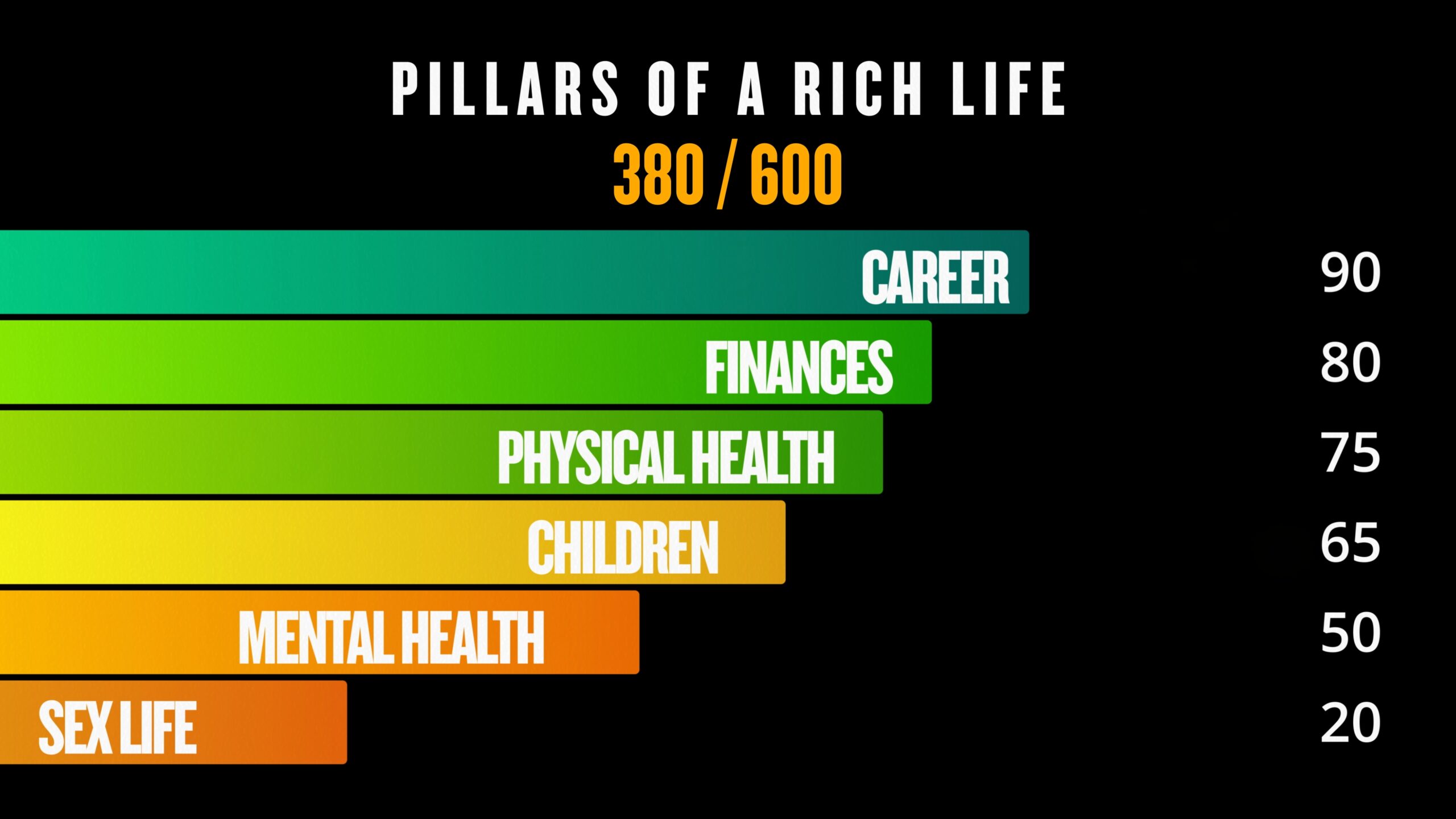
I, for one, find this genuinely motivating. The idea that I can constantly work on raising each bar a little higher: a bit more fitness, a bit more financial security, a deeper connection with my son, and a more meaningful sex life with my husband.
Because make no mistake: the sex bar is as important as any other. And you have one. We all do. We’re all sexual beings with sexual potential, whether we’re tending to that part of ourselves or not.
If culture has convinced you that a sexless marriage is no big deal and should have no impact on the quality of your life, I’m here to tell you, unequivocally, you’ve been misled.
I’ve never once witnessed a happy sexless marriage in which one partner truly needed that intimate connection to feel fulfilled. Not once.
Sexually healthy people aren’t arguing about whether sex is optional in marriage. They’re simply getting on with it, not because they’re being coerced or bursting with desire, but because they understand it matters and they make space for it.
As someone once put it, a marriage without sex is like a disco without music, and I couldn’t agree more. Sex is what sets a monogamous relationship apart from any other.
So, when it disappears, there’s often an awkward silence because the covenant of monogamy itself is being undermined, and the impact is far-reaching. All forms of physical affection tend to disappear, emotional connection weakens, conflicts escalate, and what was once a loving partnership can start to feel like a cold, logistical arrangement. Not exactly what any of us dreamed of when we said, ‘I do.’
Want help with this?
What’s Blocking Your Sexual Desire?
So, if your sex life is suffering, the question isn’t ‘Will my marriage be ok without sex?’ The question is: ‘What’s going on for me here?’ Because something is. A healthy person doesn’t avoid exercise when they get out of shape, they get moving again, and their fitness improves.
If you genuinely dread sex or actively avoid it, or if your body tenses up when your husband even tries to discuss it with you, it’s time to work out what’s really going on.
Here are the most common blocks.
Hormones and Medication
Sex hormones like testosterone and oestrogen decline with age, after childbirth, and during perimenopause and menopause. HRT can be a godsend for many women, so if you’re open to it, speak to a reputable clinic for tailored support.
Medications such as the contraceptive pill, antidepressants, and blood pressure drugs are well-known libido suppressors. Check the labels and speak to your prescriber if you have concerns.
Lifestyle Factors That Suppress Desire
Poor diet, lack of physical fitness, excessive alcohol, sleep deprivation, and chronic stress all directly suppress sex hormones and libido. Fortunately, these are all fixable with targeted lifestyle changes.
Relationship Tension and Emotional Climate
For women, relationship tension and desire can’t meaningfully coexist. If your relationship is cold or tense, address those issues with support if needed. That said, if the lack of sex has been causing the tension, then the reintroduction of sex will likely resolve it. Either way, action is required.
Early Sexual Experiences and Psychological Blocks
Early sexual experiences linked to discomfort or shame can leave a lasting mark — one that often lies dormant during the honeymoon phase, only to resurface later. Fortunately, this is healable, but it requires courage and typically some professional support. See the list of books HERE>>> Books About Sexual Desire & Relationships
Cultural Messages That Work Against Your Marriage
Some women have absorbed cultural messages that a husband’s need for sexual connection is trivial, something a wife can simply ignore or dismiss as an imposition. Reject these harmful ideologies. They do not serve your marriage.
How to Rebuild Sexual Desire: Making Intimacy Intentional
Once you’ve identified your blocks and started addressing them, the next question is more practical.
How do you reignite a flame that’s been dormant, possibly for years?
It starts with making peace with the fact that sex is an essential part of a healthy marriage. This means learning to become intentional about intimacy, much like a health-conscious person is about exercise.
For example, I don’t always wake up compelled to go for a run, but I value my health, so I put my shoes on regardless. Once I’m moving, I feel good and I’m always glad I set off. Sex works the same way. Desire follows engagement, and engagement is a choice.
So, the question isn’t “do I feel like it?” but rather “am I willing to begin?”
And to be very clear: I’m not talking about forcing yourself into unwanted sex. No one wants that, and it’s harmful to both of you. What I’m suggesting is a conscious, consenting choice to engage, for your own sexuality, for your husband, and for your marriage. It’s a health choice, not blind compliance.
Everything here hinges on personal agency and loving intent, and assumes you’re married to a supportive man who’s with you on your journey. This has to be a team effort.
Out of Your Head, Into Your Body
Commonly, even the most willing women struggle with monitoring and judging their bodies instead of being fully present during sex. Added to this, the mental load of everything else vying for your attention can create so much head noise that relaxing into pleasure can feel impossible.
The key is to get out of your head and bring your attention back into your body. Meaningful sex isn’t forced or faked or goal oriented. It comes from surrender. If you can fully relax into your body, your body will do the work. Your head is not required.
And if body image is holding you back, you’ll be relieved to know that men constantly tell me it doesn’t matter to them, at all. Your husband isn’t scrutinising your body; he’s thrilled at the chance to connect with you, his beautiful wife.
Out of head, into body. That’s your mantra.
Making Time for Intimacy in a Busy Marriage
What about time? We’ve got busy jobs, kids, and packed diaries. When on earth is there time for sex?
Most couples have more time available than they realise. If there’s time for Netflix or scrolling, there’s time for connection too.
Turn off the screens, close the door on the day as early as you can, and prioritise intimacy with your husband.
One of the therapists at my practice, Zac, talks about creating a sacred space for intimacy, and I love this idea. The concept is simple: certain environments signal to the unconscious that something different is happening.
You can easily create a sacred space like this at home: have a bath, light some candles, play some music, and just be together.
You can simply begin with environment and proximity and allow yourselves to connect at a natural pace.
And if scheduling intimacy feels silly or unromantic, I’d ask you to reconsider. Scheduled intimacy is infinitely better than no intimacy. For couples with full lives and full houses it’s often the only realistic option available.
Schedule at least one evening a week to create that sacred space together. It doesn’t have to be all your intimate life involves, far from it, but if intimacy has been difficult, it’s a great place to start.
Real stories from wives
Is It Worth the Effort?
Real Wives Answer
Read this if you’re a wife and you’re sceptical.
Don’t just take my word for it. I’ve heard from dozens of wives who stopped waiting to be in the mood, and their stories are wonderful. Women who thought their desire had gone for good are enjoying sex again, often to their own surprise.
Will I Ever Actually Want Sex Again?
We’ve talked about addressing blocks and making intimacy intentional. But that’s not the same as wanting sex, which is likely the reason you’re reading this.
Here’s the thing: over years of practice and in my own life, I’ve consistently observed that intentional intimacy, within the context of a loving marriage, often creates a positive feedback loop, where desire naturally follows. It’s like getting fit; you start feeling good, so your desire to exercise grows. Or getting a handle on your finances; the sense of security motivates you to do more. Likewise, once the very real benefits of a rich sexual life become tangible, your desire to engage naturally increases. You begin to crave it, just like any other self-rewarding area of health you invest in.
But this is all highly contingent on addressing the blocks mentioned earlier. It doesn’t matter how much you want to want sex. If you’re not sleeping, not exercising, drinking too much, taking a ton of meds, or carrying unresolved resentment, the wanting won’t materialise. Genuine sexual desire tends to flourish within a holistic, healthy lifestyle, underpinned by loving intent and decisive action until eventually it flows effortlessly.
Your Sex Life Belongs to You — Look After It
Remember, your sex life is yours. It’s a beautiful and unique part of what makes you the woman you are. If it’s suffering, a part of you is suffering, and that’s not something to minimise or ignore.
A woman who’s in command of her sexuality is often getting a lot right in her life. She’s in control of her health, connected to her body, and secure in herself. She understands that a life with a healthy sexuality is richer and more fulfilling than one without, and so she pursues it with intention.
And all it takes, as with any other health transformation, is a decision and a commitment to acknowledge: “This matters and so I’m going to make it happen.”

Women-only community
The Good Wife Club
A warm, women-only community led by Laura How. Somewhere to learn what actually makes a marriage thrive.

Men-only community
The Good Husband Club
A warm, men-only community led by Laura How. Somewhere to learn what actually makes a marriage thrive.
Ready to Take the Next Step?
If you’d like some support to work through this with your husband, I run One-Day Couples Intensives — a full day with me, designed to identify your specific issues and give you both a clear path forward. The link is below.
1-Day Intensive for Women
Ready to want him again?
One focused day with Laura, just for you. Understand what happened to your desire, and leave with a personalised plan to bring it back.
- Morning Discovery
- Afternoon Recovery
- Online or in Somerset
- Action plan within 7 days
Investment £2,250
And if you’re looking for ongoing support, you can reach out to me or my team HERE >>> Therapy for Female Sexual Desire
To yourself and to the people you love — tell the truth.
Recommended Reading About Intimacy in Marriage

His Needs, Her Needs
‘This book will educate you in the care of your spouse,’ explains Dr Willard Harley. ‘Once you have learned its lessons, your spouse will find you irresistible, a condition that’s essential to a happy and successful marriage.’
This fresh and highly entertaining book identifies the ten most important needs within marriage for husbands and wives. It teaches you how to fulfil each other’s needs. Couples who find each other irresistible during the early years of their marriage may become incompatible if they fail to meet these central needs. According to Dr Harley, the needs of men and women are similar, but their priorities are vastly different.
Are you able to identify which of the following needs are his and which are hers? In what order would you place them? Admiration, Affection, An attractive spouse, Conversation, Domestic support, Family commitment, Financial support, Honesty and openness, Recreational companionship, Sexual fulfilment.

The Passionate Marriage
Passionate Marriage has long been recognized as the pioneering book on intimate human relationships. Now with a new preface by the author, this updated edition explores the ways we can keep passion alive and even reach the height of sexual and emotional fulfillment later in life. Acclaimed psychologist David Schnarch guides couples toward greater intimacy with proven techniques developed in his clinical practice and worldwide workshops. Chapters―covering everything from understanding love relationships to helpful “tools for connections” to keeping the sparks alive years down the road―provide the scaffolding for overcoming sexual and emotional problems. This inspirational book is sure to help couples invigorate their relationships and reach the fullest potential in their love lives.

The Sex-Starved Marriage
Bring the spark back into your bedroom and your relationship with gutsy and effective advice from bestselling author Michele Weiner Davis. It is estimated that one of every three married couples struggles with problems associated with mismatched sexual desire. If you want to stop fighting about sex and revitalize your intimate connection with your spouse, then you need this book. In “The Sex-Starved Marriage,” bestselling author Michele Weiner Davis will help you understand why being complacent or bitter about ho-hum sex might cost you your relationship. Full of moving first-hand accounts from couples who have struggled with the erosion of sexual desire and rebuilt their passionate connection, “The Sex-Starved Marriage” addresses every aspect of the sexual libido problem.
Ready to start?
Book a session with Laura, online worldwide or in person in Somerset.

I have ordered the book you recommended