
Is Sex Optional in Marriage?
For Couples
Why sexual intimacy is a shared responsibility in marriage.
01
Is Sexual Intimacy Optional in Marriage?
Please read first
This article only applies to marriages that are fundamentally safe and loving. None of the advice here applies to marriages involving any kind of coercion or abuse. Sex is important, but safety always comes first. If you feel unsafe in your marriage, then sex is not what you should be working on. Please seek professional support.
Sexual intimacy in marriage is one of the most misunderstood and avoided topics in long-term relationships. Whether you are dealing with a sexless marriage, low desire, or ongoing intimacy problems, the question often comes down to this: is sex optional in marriage? This is about not letting something this important disappear, rather than duty or sex on demand. This page explores the role of sex in monogamy, the impact of sexual withdrawal, and what healthy couples do to maintain connection, desire, and long-term relationship satisfaction.
The short answer is no, unless you have both had an honest conversation about what its absence means for each of you.
A monogamous marriage is, by its nature, a sexually exclusive relationship. When you agree not to have sex outside the marriage, you implicitly agree that sex will happen within it. Which means any change to that arrangement isn’t one person’s decision to make. It belongs to both of you.
So while anyone has a right to opt out of sex, at some point, opting out of sex in your marriage starts to look a lot like opting out of the marriage itself.
The clinical definition of a sexless marriage is straightforward: fewer than ten sexual encounters per year. But that threshold misses the point for most couples who are struggling. A couple having sex twelve times a year where one partner feels consistently rejected, unseen, or unwanted is not in a healthy marriage simply because they technically clear the bar. And a couple having sex less frequently than they once did, but where both feel desired, connected, and close, may not be in crisis at all.
Fulfilment matters more than frequency. What defines the problem is the feeling, for one or both partners, that something important has gone, and that raising it is either pointless or too risky to attempt.
If that is where you are, the number of times you had sex last year matters far less than what that pattern means for both of you, and what is driving it.
About Laura
About Laura
A sexless marriage is a relationship problem as much as a bedroom one, so both partners need to address it together.
Laura How is a relationship therapist specialising in sexless marriage, desire mismatch, and intimacy breakdown. This page draws on her clinical experience and research to explain why sexual intimacy breaks down and what actually works to rebuild it. She works with couples and individuals worldwide, helping them restore intimacy, emotional connection, and sexual confidence. Laura also shares insights on relationships and intimacy with an audience of over 52,000 subscribers on YouTube and through her Love & Cherish podcast.

02
Why Sex in Marriage Is a Shared Responsibility
From the moment you get married, you are no longer just two individuals living individual lives. You have a shared life, and every decision you make affects it, whether you intend it to or not. Your spending habits, your physical and mental health, your emotional availability; all of these directly impact the wellbeing of the person you married. Sex operates on exactly the same logic.
You could not unilaterally empty the joint account on a whim, check out emotionally, or drink yourself to sleep every night and call it a personal lifestyle choice, because your spouse lives with the consequences of those decisions. The sexual side of your marriage is no different. What makes it uniquely significant is that, unlike almost any other need, monogamy offers nowhere else to turn if it disappears.
If a sexual bond matters to one of you, then by default it matters to the marriage. There is no getting around that.
Sex is a shared space, something you are both responsible for tending, rather than something one person does to another. And like any shared part of a marriage, it does not look after itself. It requires both of you to contribute to its health for it to flourish.
Desire discrepancy; where one partner wants sex more than the other is the norm in long-term relationships, not the exception. It only becomes a problem when it goes unaddressed. The higher-desire partner feels rejected and resentful. The lower-desire partner feels pressured and avoidant. Without honest conversation, the gap widens until intimacy feels impossible to restore.
In a marriage, you can’t say ‘I’m not having sex anymore’ without also saying ‘you’re not having sex anymore.’
Laura How
03
What Sexual Rejection Does to a Marriage Over Time
Marriages rarely collapse because of one dramatic event. They disintegrate through the accumulation of small but repeated rejections. Each one feels minor in isolation, but compounded over months and years, they become devastating.
The consequences of sexual neglect are far-reaching. Emotional connection begins to dry up and, without physical intimacy, feelings of isolation become the norm. When sex disappears, so do the hugs, the casual touches, and the everyday warmth that sustain closeness. A familiar cycle follows: one partner feels rejected, the other pressured, and over time that cycle destroys kindness and communication.
As psychotherapist David Schnarch observed, some marriages drift into patterns of covert punishment, withholding, and quiet hostility, what he called “normal marital sadism.” Most couples are not doing this consciously, but naming the pattern matters, because once couples can see it they can begin to take responsibility for their part in it.
Left unaddressed for long enough, what the Gottmans identify as the four horsemen move into the marital home: criticism, contempt, defensiveness, and stonewalling. Once these patterns are established, they are very difficult to reverse without help.
And the impact does not stay confined to the couple. Longitudinal Gottman research shows that children raised in affectionate, connected homes develop stronger emotional regulation and better conflict resolution skills as adults. Conversely, when a marriage turns cold or platonic, children feel that too. A home marked by emotional or sexual disconnection can shape a child’s understanding of what relationships look like, often in ways that linger long into their adult lives.
Want help with this?
04
Is It Coercive to Want Your Spouse to Care About Your Sex Life?
This is the question that shuts down more conversations than almost any other, and it deserves a careful answer.
Within the context of a safe, stable, and loving marriage: no. Expecting your spouse to care about the sexual health of your marriage is reasonable, because it is the same expectation you bring to every other shared pillar of the relationship.
Every part of marriage comes with expectations. You are expected to show up emotionally, to be kind on difficult days, to manage your finances responsibly, and to remain accountable for the life you are building together. Nobody calls that coercion. It is simply what a shared life requires, the discipline of being committed to your partner’s wellbeing, and the willingness to occasionally put the needs of the marriage above your own comfort.
Show up emotionally
Be kind on difficult days
Manage your finances responsibly
Care about your sexual connection
Sex is no different.
There is a shared responsibility in a loving marriage not to neglect the sexual bond. That means mutual accountability to care about how things are going for both of you, rather than a transactional demand for one partner to engage when they really do not want to. The willingness to ask “how do we get back on track?” when it gets difficult, rather than simply accepting that it has.
Wanting it not to matter, or feeling like it shouldn’t, does not make it so. You can argue with it, minimise it, or intellectualise it, but it will still show up somewhere. Usually as distance, resentment, or a disconnection that neither partner can quite name.
The wiser move is to make peace with it, and to find real pleasure in it, because sex at its best between two committed people is a profoundly moving experience. A physical, emotional, and spiritual union that develops trust, encourages vulnerability, deepens your knowledge of each other, and provides a real sense of belonging. Treating it as a battleground, a bargaining chip, or something dark and threatening is a profound distortion of what it actually is.
05
What Is Psychosexual Health and Why Does It Matter in Marriage?
Most people invest heavily in their careers, their finances, their physical fitness, their parenting. Very few think to invest in their psychosexual health, and yet it is just as vital to the shared life they are building.
Your psychosexual health encompasses how you feel about sex, your desire for it, your relationship with your own body, any shame or history you are carrying around it, and whether your sexuality feels like something that truly belongs to you. It includes whether you move towards intimacy or away from it, whether you can talk about it openly with your partner, and whether your partner’s experience really matters to you.
Because the body and the person are one. For many people, physical intimacy is the primary way they feel loved, so loving your spouse means being attuned to their body as well as their emotional life. Their body and their sexuality are an inseparable part of the person you married.
Part of the reason psychosexual health is so often neglected is cultural. Our society has built such an anxious, pessimistic view of sex in marriage that many couples unwittingly absorb that toxicity. Language designed for unsafe situations gets misapplied inside loving relationships, and it shuts down any chance of building a real intimate bond. Casual, meaningless sex is celebrated as empowering, while healthy, loving marital sex is portrayed as dutiful at best, or something to avoid entirely at worst.
The couples who thrive sexually in the long term tend to have done the work on themselves individually as well as together. They understand what sex means to them, they have made peace with their own desires, and they bring that understanding to the relationship as a real offering rather than an obligation.
06
The Consequences of Sexual Neglect in Marriage
No amount of chore charts, date nights, or communication exercises can repair a marriage where the erotic disconnection at its heart goes unaddressed. Sexual neglect doesn’t stay in the bedroom. Its consequences spread through every aspect of a shared life.
When intimacy disappears, trust erodes alongside it. Sex and trust are deeply interdependent. You cannot have meaningful sexual connection without a real sense of safety, and sexual intimacy actively builds trust in ways that conversation alone cannot replicate. When sex goes, trust lowers. When trust lowers, sex feels even less safe. The two feed each other in both directions, which is also why restoring one can begin to restore the other.
The research is consistent and stark. Partners in sexless marriages are significantly more likely to report feelings of loneliness, anxiety, and depression. They are more likely to consider divorce, more likely to experience affairs, and more likely to describe their relationship as a housemate arrangement than a marriage. There are no positive outcomes for a sexless marriage where one partner wants more and the other has simply opted out.
The couples who understand this do not treat sex as optional. They treat it as part of what they chose when they chose each other.
1-Day Couples Intensive
Is your marriage in crisis?
One focused day with Laura. The depth of 8–10 weekly sessions, with real momentum, and a personalised action plan to take home.
- Morning Discovery
- Afternoon Recovery
- Online or in Somerset
- Action plan within 7 days
Investment £2,250
07
How Intentional Intimacy Keeps a Marriage Alive
One of the most important things couples can understand about long-term sexual connection is that it rarely happens spontaneously. It happens because couples choose to make it happen.
Many people do not experience desire before intimacy begins, they experience it once it has started. Rosemary Basson’s model of responsive desire, now well established in the research literature, shows that waiting to feel like it almost guarantees sex never happens. This is simply how desire functions for a significant proportion of people in established relationships, and understanding it removes a layer of shame and confusion for both partners.
Spontaneous desire
- Desire
- Arousal
- Intimacy
Responsive desire
- Willingness
- Touch
- Arousal
- Desire
Being deliberate about sex can feel unromantic, but it is an act of mature love, a conscious practice of giving and receiving, of making time for each other sexually as reliably as you show up practically or emotionally. In every other part of a loving relationship, we extend ourselves: making a meal when we are tired, listening when we would rather be elsewhere, showing up when it is inconvenient. Sexual intimacy is no different, and research on sexual communal motivation confirms that when both partners prioritise each other’s wellbeing, both sexual and relationship satisfaction improve.
Regular, satisfying sex is consistently linked to greater wellbeing, better physical health, and more resilient relationships. The couples who maintain it tend not to be the ones with the highest spontaneous desire, they are the ones who have decided that it matters and act accordingly.
Many couples remain sexually connected well into their eighties and nineties. It may not look anything like it did in their twenties, there may even be limited physical contact, but they are showing up, making the best of what they have, and they are more alive for it. This youthful energy radiates for anyone who has the eyes to see it.
The couples who get this right are simply intentional about making time for each other sexually, as reliably as they do practically or emotionally.
Laura How
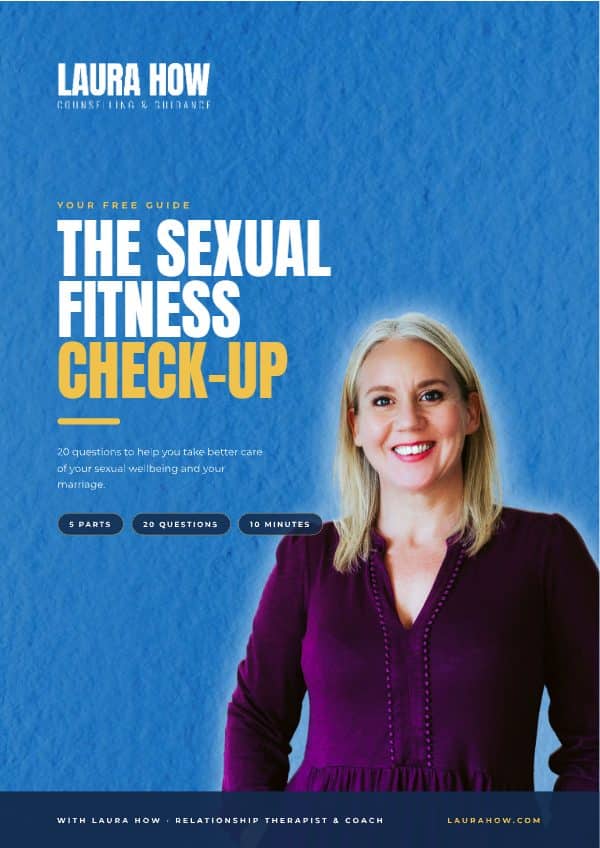
Free download
How sexually fit is your marriage?
The free Sexual Fitness Check-Up: 20 questions to see what’s working in your sex life, what needs attention, and where a little effort could make a big difference.
- 20 quick questions
- See what’s working and what needs attention
- For men, women and couples
Thank you! Check your inbox and confirm your email, then your check-up will be on its way.
By entering your email you’re signing up to my monthly newsletter. Unsubscribe any time.
Read about sexual fitness08
Common Barriers to Sexual Intimacy and How Healthy Couples Handle Them
Sexually healthy couples face difficulties just like everyone else. Relationship friction, the arrival of children, menopause, perimenopause, body image struggles, erectile dysfunction, low testosterone, vaginismus, performance anxiety, mismatched desire, chronic stress, grief, trauma, and shame; the list is long, and none of it is unusual. None of it is a dead end either, and most of it is workable if both people are willing to face it.
The difference between couples who work through these barriers and those who don’t comes down to willingness, more than luck or compatibility. They talk about what is happening rather than avoiding it. They investigate the causes and look for solutions. They go to the doctor or to therapy. They approach every obstacle as an invitation to bring more intentionality to this part of their marriage (not less) because they understand that a healthy sex life is part of what keeps their marriage alive.
It is also worth asking a harder question: is the sexlessness the cause of the disconnection between you, or a reflection of it? If intimacy broke down first, rebuilding it intentionally can be the catalyst for wider repair. If it followed betrayal, ongoing hostility, or deep resentment, the emotional healing has to come first. Knowing which is true for you matters, because it changes where you begin.
09
What Sexually Vibrant Couples Look Like
The difference between couples who maintain a sexual bond and those who don’t is night and day. It does not take long to notice.
They are lighter, more playful, more energetic. They are relaxed together and enjoy each other’s company. They cope with stress better, argue less, and feel less lonely. Research consistently shows they report greater relationship satisfaction, lower rates of depression and anxiety, and stronger immune function. They even live longer. And their children growing up in the warmth of two people who have chosen each other, tend to be more emotionally secure and better equipped for their own relationships in adulthood.
The couples who get this right simply understand that this part of their marriage deserves the same care and attention as every other part, that it needs to be noticed when it slips, talked about when something threatens it, and protected as the shared and valuable thing it is. They don’t wait for spontaneous desire to carry them. They are intentional about making time for each other sexually, as reliably as they do practically or emotionally.
Ask any couple who is getting it right, and they will tell you it is among the best investments they have ever made in each other.
What My Couples Say
“Laura was our last hope as a couple. We were in such a bad place that we even fought on the way to our first session. Communication felt impossible. Laura met us in that space and helped us rebuild it. We now leave sessions feeling hopeful, understood, and more connected than we thought possible.”
Susan
“Initially we considered Laura to be our couples counsellor from the reviews, then after meeting with Laura for an initial chat, we knew that Laura would be our choice, based on how she just got what was going on for us so quickly and what needed to change for us to move forward in our relationship.”
Julie
“Couples counselling with Laura exceeded our expectations. She guided us with warmth, honesty, and empathy. We felt supported but also challenged in the right ways. The changes we made have strengthened our relationship, and we are truly grateful for the experience.”
Yanka
10
When a Sexless Marriage Needs Professional Support
Some situations are too entrenched to move without help. Months or years of mutual withdrawal, compounding barriers, resentment that has hardened into the wallpaper of the relationship, these rarely resolve through goodwill alone. If you have been trying and not getting anywhere, you haven’t failed. It means the patterns between you need skilled support to shift.
One sign that professional help has become necessary is when physical avoidance has spread beyond sex entirely. Many couples in this situation stop kissing properly, stop touching, stop reaching for each other in the small everyday ways that once came naturally. A hug becomes awkward. A kiss goodbye disappears. The body learns to stay at a safe distance, and over time that distance hardens into the new normal. When affection itself has been lost (not just sex) the gap has usually grown too wide to close without help.
Coming early makes the work faster and the outcomes significantly better. Therapy doesn’t have to be a last resort, and it is often the thing that turns real effort into real change.
The average time couples wait before getting help, by which point patterns are far harder to shift.
11
Ready to Get Support?
If you’re struggling in a sexless marriage, working with a therapist who understands intimacy and long-term relationship dynamics can make a significant difference.
All of our therapists deliver the ‘Laura How’ approach. The same research-backed, solution-focused methodology featured in our YouTube content and podcast. They all specialise in sexless marriage, and Laura mentors each of them closely, so whoever you choose, you’re in good hands. They each bring their own personality and experience, but the framework is the same. And you’ll stay with the same therapist from your first session to your last.

Laura How
Therapist & Coach
Female sexual desire specialist. Works with couples where sex has become difficult, and is direct, practical and never takes sides.
- £240 an hour
- Tuesday to Friday
- Online or in person in Axbridge

Zac Fine
Masculinity Therapist
Works with couples struggling with physical intimacy, and with men who’ve lost their voice in their marriage.
- £144 an hour
- Monday, Tuesday and Thursday
- Online

Marijke Roberts
Integrative Counsellor
Works with couples who are stuck, have drifted apart, or where trust has been broken. Also experienced with young people.
- £144 an hour
- Monday and Tuesday
- Online

Scott Bennion
Relationship & Intimacy Coach
Certified sexologist helping couples with sexless marriages and desire differences. Works especially well with Christian couples.
- £216 an hour
- Tuesday to Thursday
- Online, from Arizona
12
Frequently Asked Questions About Sexless Marriage & Couples Therapy
If you’re here, you’re probably exhausted. You may have tried talking, arguing, ignoring it, fixing yourself, fixing them, reading, researching, even giving up. A sexless marriage rarely happens overnight, and it rarely has a single cause.
These are the questions couples most often ask before they reach out.
Is sex optional in marriage?
In a monogamous marriage where both partners want it, the honest answer is no, unless you have both talked it through openly. When you agree to sexual exclusivity, you implicitly agree that sex will happen within the marriage. Any change to that belongs to both of you. This only applies to marriages that are fundamentally safe and loving. Where there is any coercion or abuse, safety always comes first.
Can one partner just decide to stop having sex in a marriage?
They can, but it is not a decision that affects only them. Within a monogamous marriage, opting out of sex removes something from a partner who has no alternative. That is worth taking seriously, not framing as a personal lifestyle choice.
Is it coercive to want your spouse to care about your sex life?
Within a safe and loving marriage, no. There is a shared responsibility not to neglect the sexual bond, the same way there is a shared responsibility not to neglect the finances or emotional connection. That is what a committed shared life requires.
What happens to a marriage when sex disappears?
The consequences rarely stay in the bedroom. Emotional connection erodes, everyday affection disappears, trust weakens, and resentment builds. Research consistently links long-term sexual disconnection to loneliness, depression, and significantly higher rates of divorce.
Is it selfish to want sex in your marriage?
No. Wanting intimacy with your spouse is reasonable, because it is a legitimate relational need. The question is how that desire is expressed. With entitlement it damages connection, with honest vulnerability it invites it.
Does sex really matter that much in a marriage?
The research says yes. Couples who maintain a healthy sexual connection report greater relationship satisfaction, better mental and physical health, and longer lives. There are no equivalent benefits documented for long-term sexual disconnection.
When does a sexless marriage need professional help?
When the same conversations go in circles, when physical affection has disappeared alongside sex, or when one partner has stopped engaging with the issue entirely. The average couple waits six years, by which point patterns are far harder to shift.
Why clients trust Laura
Trust & Professional Standards
My therapy is direct, practical and solution-focused. Whether it’s your relationship or something you’re struggling with on your own, we’ll work on changes that last.

Qualified since 2011
Diploma in Counselling from the University of the West of England, a BACP-accredited course.
20+ years’ experience
Over twenty years. I started out in a women’s refuge and in addiction services, and that led to the relationship work I do now.
Insured & supervised
Fully insured, with regular professional supervision.
A published Code of Ethics
I’ve published a Code of Ethics covering confidentiality, safeguarding and complaints. Read the Code of Ethics.
Happily married
I practise what I preach. Russell and I nearly didn’t make it through our own storms, and our marriage is the thing I’m proudest of.
52,000+ on YouTube
Have a look at my YouTube channel first if you want to see how I work.
Book a Session
Book a session with Laura, online worldwide or in person in Somerset.
laura@laurahow.com