

The Linguistic Trap About Sex in Marriage
If you’ve ever been told that sex isn’t a real need in marriage, you’re not alone, and you’re not wrong to push back. In this post, I dismantle the myth that sexual intimacy is optional, drawing on brain science, attachment research, and the latest studies on sexual satisfaction and relationship health to explain why dismissing your need for connection is a form of stonewalling, and what to do about it.
It’s become painfully clear that a lot of men are being prevented from having an honest conversation about sex in their marriage. The moment you try to voice your needs – or even dare to suggest they are needs – you’re shut down with dismissive or shaming language.
Here are a few actual comments from my channel. You might be hearing something similar at home:
“Sex is not a basic human need.”
“Monks live without sex just fine.”
“Sex is a luxury, not a necessity.”
“You don’t need sex to survive.”
“Sex is optional.”
“Not a need, just a want.”
If you’re facing this rhetoric in your marriage, and it’s making you feel invisible, dismissed or even crazy, then this post is for you. I’m going to show you why this isn’t just linguistically and scientifically wrong; but more importantly, what these statements are really doing to your marriage, and how to begin the process of identifying the real issue underneath them.
A quick disclaimer: This post doesn’t apply to marriages involving genuine coercion, abuse, or trauma. I’m speaking to good men in otherwise healthy marriages who understand consent and reciprocity deeply – but whose needs are dismissed as invalid.
Why “Sex Is Just a Want” Is a Thought-Terminating Cliché in Marriage
Saying “sex is just a want” is a thought-terminating cliché. It’s a conversational dead end, and it carries the insinuation that any pushback is coercion – which no self-respecting man wants to be accused of.
So, let’s dismantle the biggest linguistic trap in this debate: the convenient conflation of “survival” with “need,” which only seems to apply when discussing men and sex.
No one’s arguing that sex is a survival need. But what a tragedy it would be if we decided the only legitimate needs in marriage were those that prevent early death.
Need a hug? Need to talk? Need to feel seen and valued? Sorry – not needs.
That’s not what the word “need” means. – A need, by dictionary definition, is: “a physiological or psychological requirement for the well-being of an organism.” And sexual intimacy, by every available metric across multiple serious studies, is indeed a psychological requirement for the well-being of an individual. ⁽¹⁾
What Sexual Intimacy Means for Men in Marriage
I say psychological because that’s what the need for sexual intimacy really is. Men can obviously take care of the physical release themselves – but that’s not what we’re talking about.
Sexual intimacy in marriage is about emotional connection, bonding, and feeling wanted. It’s one of the most important ways many men experience and communicate love. ⁽²⁾ So, when it’s withdrawn, pain is inevitable. And the research on this is clear.
The Science Behind Why Intimacy Is a Psychological Need
We know from brain imaging studies that social rejection activates the same pain-processing systems as physical injury. ⁽³⁾ And when touch and intimacy are absent, stress hormones rise and immune function drops, making your body more vulnerable to illness and infection. ⁽⁴⁾
This is why the research consistently describes intimacy as a basic psychological need. Sexual connection activates our attachment systems, increasing feelings of safety and emotional bonding in both men and women – and that’s closely tied to better mental health. ⁽⁵⁾ ⁽⁶⁾
Longer-term studies show that couples with satisfying sexual relationships don’t just report being happier. They show lower stress levels, better physical health, and reduced long-term health risks. ⁽⁷⁾ ⁽⁸⁾ There’s even a clear correlation: more consistent sexual connection is associated with better overall health and lower mortality. ⁽⁹⁾
This is why therapists don’t (or shouldn’t) treat sex as an optional extra in marriage, but as a core part of the bond. ⁽¹⁰⁾ Because ongoing sexual rejection doesn’t just signal a problem in the relationship—it’s also known to cause measurable psychological harm. ⁽¹¹⁾
The Difference Between a Celibate Monk and a Sexless Marriage
And that’s the key word: rejection.
Because it’s not the absence of sex that causes the suffering – it’s being rejected, especially by the only person on earth you’ve chosen to share that part of your life with. ⁽³⁾
This is the critical difference between a celibate monk and a touch-starved husband. Monks don’t suffer because they’re not being rejected. They choose celibacy as a spiritual path. They’re not in conflict with desire because it is their desire.
So, given all this evidence – the brain science, the physical health impacts, the professional consensus – it simply isn’t reasonable to say that sex isn’t a legitimate need in a monogamous relationship.
Why Many Wives Don’t Understand What Sex Means to Their Husband
Why then do so many women still insist that it isn’t?
The truth is that many women have no idea that for most men, sex is about emotional connection, feeling wanted, and feeling like they matter – that it’s something they need to feel loved. They’ve bought into the widely accepted myth that sex is nothing but a meaningless physical release for men. ⁽¹²⁾
So, the first step is to communicate the truth about what sexual intimacy actually represents for you. ⁽¹³⁾ I’ve seen this be effective many times: if you clearly articulate this to her, the misunderstanding can often be resolved. Sometimes, immediately.
What to Do When Your Wife Dismisses Your Need for Intimacy
But if you’ve communicated what it means to you and the response remains dismissive, what you’re actually dealing with is: “I don’t want to.“
And “I don’t want to” is the start of a long conversation, not the end of a short one. ⁽¹⁴⁾
So now the question becomes: why? Why is she unwilling to talk about something so important to your marriage?
And just to be crystal clear – none of this is about pressuring women to have sex they don’t want. No one wants that, and it’s certainly not what I’m suggesting.
What I’m saying is that claiming sex isn’t a need is simply false – and all it does is shut down the real conversation you should be having. Simply put, it’s a form of stonewalling. ⁽¹⁵⁾
How to Talk About Sex in Your Marriage Without It Turning Into a Fight
You have every right to express disappointment if you’re not having sex, and it’s perfectly normal to want to understand what’s getting in the way. If she’s unwilling to explore what’s going on with you, then respectfully, she has work to do.
It might not be an easy conversation – perhaps because sex is often more challenging for women – but it’s a necessary one. ⁽¹⁶⁾ And word games, whether played consciously or not, have no place in it. Sometimes, to get to the truth you have to cut through the noise.
Once you’ve done that, most issues can be solved as a team with empathy, curiosity and generosity. ⁽¹⁷⁾
Why Mutual Generosity Is the Foundation of a Healthy Marriage
Marriages thrive only when both partners genuinely care about each other’s needs – whatever those may be – not out of pressure, but because they truly want their partner to feel loved and valued. ⁽¹⁸⁾
This spirit of mutual generosity is fundamental to a successful marriage, and will sometimes involve working through discomfort, fear or complexity together. ⁽¹⁹⁾ Our individual commitment to this work is an act of love in itself. ⁽²⁰⁾
Love is action, after all.
If you’re struggling with any of the topics raised in this post, you can reach out to me or my team HERE.
Until next week – to yourself and to others, tell the truth.
IS YOUR MARRIAGE IN CRISIS?
Book a 1-Day COUPLES Intensive with me

Laura How
Relationship Counsellor & Coach

Recommended Reading About Intimacy in Marriage

His Needs, Her Needs
‘This book will educate you in the care of your spouse,’ explains Dr Willard Harley. ‘Once you have learned its lessons, your spouse will find you irresistible, a condition that’s essential to a happy and successful marriage.’
This fresh and highly entertaining book identifies the ten most important needs within marriage for husbands and wives. It teaches you how to fulfil each other’s needs. Couples who find each other irresistible during the early years of their marriage may become incompatible if they fail to meet these central needs. According to Dr Harley, the needs of men and women are similar, but their priorities are vastly different.
Are you able to identify which of the following needs are his and which are hers? In what order would you place them? Admiration, Affection, An attractive spouse, Conversation, Domestic support, Family commitment, Financial support, Honesty and openness, Recreational companionship, Sexual fulfilment.
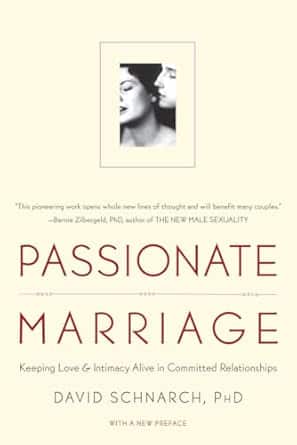
The Passionate Marriage
Passionate Marriage has long been recognized as the pioneering book on intimate human relationships. Now with a new preface by the author, this updated edition explores the ways we can keep passion alive and even reach the height of sexual and emotional fulfillment later in life. Acclaimed psychologist David Schnarch guides couples toward greater intimacy with proven techniques developed in his clinical practice and worldwide workshops. Chapters―covering everything from understanding love relationships to helpful “tools for connections” to keeping the sparks alive years down the road―provide the scaffolding for overcoming sexual and emotional problems. This inspirational book is sure to help couples invigorate their relationships and reach the fullest potential in their love lives.

The Sex-Starved Marriage
Bring the spark back into your bedroom and your relationship with gutsy and effective advice from bestselling author Michele Weiner Davis. It is estimated that one of every three married couples struggles with problems associated with mismatched sexual desire. If you want to stop fighting about sex and revitalize your intimate connection with your spouse, then you need this book. In “The Sex-Starved Marriage,” bestselling author Michele Weiner Davis will help you understand why being complacent or bitter about ho-hum sex might cost you your relationship. Full of moving first-hand accounts from couples who have struggled with the erosion of sexual desire and rebuilt their passionate connection, “The Sex-Starved Marriage” addresses every aspect of the sexual libido problem.
References
⁽¹⁾ Baumeister, R. F., & Leary, M. R. (1995). The need to belong: Desire for interpersonal attachments as a fundamental human motivation. Psychological Bulletin, 117(3), 497–529. https://doi.org/10.1037/0033-2909.117.3.497 Accessible: https://pubmed.ncbi.nlm.nih.gov/7777651/
⁽²⁾ Birnbaum, G. E., Reis, H. T., Mikulincer, M., Gillath, O., & Orpaz, A. (2006). When sex is more than just sex: Attachment orientations, sexual experience, and relationship quality. Journal of Personality and Social Psychology, 91(5), 929–943. https://doi.org/10.1037/0022-3514.91.5.929 Accessible: https://pubmed.ncbi.nlm.nih.gov/17059310/
⁽³⁾ Kross, E., Berman, M. G., Mischel, W., Smith, E. E., & Wager, T. D. (2011). Social rejection shares somatosensory representations with physical pain. Proceedings of the National Academy of Sciences, 108(15), 6270–6275. https://doi.org/10.1073/pnas.1102693108 Accessible: https://pmc.ncbi.nlm.nih.gov/articles/PMC3076808/
⁽⁴⁾ Ditzen, B., Hoppmann, C., & Klumb, P. (2008). Positive couple interactions and daily cortisol: On the stress-protecting role of intimacy. Psychosomatic Medicine, 70(8), 883–889. https://doi.org/10.1097/PSY.0b013e318185c4fc Accessible: https://pubmed.ncbi.nlm.nih.gov/18842747/
⁽⁵⁾ Birnbaum, G. E., & Reis, H. T. (2019). Evolved to be connected: The dynamics of attachment and sex over the course of romantic relationships. Current Opinion in Psychology, 25, 11–15. https://doi.org/10.1016/j.copsyc.2018.02.005 Accessible: https://pubmed.ncbi.nlm.nih.gov/29494853/
⁽⁶⁾ Mizrahi, M., Hirschberger, G., Mikulincer, M., Szepsenwol, O., & Birnbaum, G. E. (2016). Reassuring sex: Can sexual desire and intimacy reduce relationship-specific attachment insecurities? European Journal of Social Psychology, 46(4), 467–480. https://doi.org/10.1002/ejsp.2184 Accessible: https://onlinelibrary.wiley.com/doi/full/10.1002/ejsp.2184
⁽⁷⁾ McNulty, J. K., Wenner, C. A., & Fisher, T. D. (2016). Longitudinal associations among relationship satisfaction, sexual satisfaction, and frequency of sex in early marriage. Archives of Sexual Behavior, 45(1), 85–97. https://doi.org/10.1007/s10508-014-0444-6 Accessible: https://pmc.ncbi.nlm.nih.gov/articles/PMC4472635/
⁽⁸⁾ Meltzer, A. L., Makhanova, A., Hicks, L. L., French, J. E., McNulty, J. K., & Bradbury, T. N. (2017). Quantifying the sexual afterglow: The lingering benefits of sex and their implications for pair-bonded relationships. Psychological Science, 28(5), 587–598. https://doi.org/10.1177/0956797617691361 Accessible: https://pubmed.ncbi.nlm.nih.gov/28485699/
⁽⁹⁾ Teng, T. Q., Liu, J., Wang, M. M., Mo, D. G., Chen, R., Xu, J. C., Dong, Z. H., Zhang, N., & Yu, H. C. (2024). The association of sexual frequency with cardiovascular diseases incidence and all-cause mortality. Scientific Reports, 14(1), 31925. https://doi.org/10.1038/s41598-024-83414-3 Accessible: https://pmc.ncbi.nlm.nih.gov/articles/PMC11685605/
⁽¹⁰⁾ Johnson, S. M. (2008). Integrating sex and attachment in emotionally focused couple therapy. Journal of Marital and Family Therapy, 34(4), 431–445. https://doi.org/10.1111/j.1752-0606.2008.00091.x Accessible: https://pubmed.ncbi.nlm.nih.gov/18834364/
⁽¹¹⁾ Eisenberger, N. I., Lieberman, M. D., & Williams, K. D. (2003). Does rejection hurt? An fMRI study of social exclusion. Science, 302(5643), 290–292. https://doi.org/10.1126/science.1089134 Accessible: https://pubmed.ncbi.nlm.nih.gov/14551436/
⁽¹²⁾ Muise, A., & Impett, E. A. (2016). Applying theories of communal motivation to sexuality. Social and Personality Psychology Compass, 10(8), 455–467. https://doi.org/10.1111/spc3.12261 Accessible: https://compass.onlinelibrary.wiley.com/doi/10.1111/spc3.12261
⁽¹³⁾ Yoo, H., Bartle-Haring, S., Day, R. D., & Gangamma, R. (2014). Couple communication, emotional and sexual intimacy, and relationship satisfaction. Journal of Sex & Marital Therapy, 40(4), 275–293. https://doi.org/10.1080/0092623X.2012.751072 Accessible: https://pubmed.ncbi.nlm.nih.gov/24111536/
⁽¹⁴⁾ Muise, A., Kim, J. J., Impett, E. A., & Rosen, N. O. (2017). Understanding when a partner is not in the mood: Sexual communal strength in couples transitioning to parenthood. Archives of Sexual Behavior, 46(7), 1993–2006. https://doi.org/10.1007/s10508-016-0920-2 Accessible: https://pubmed.ncbi.nlm.nih.gov/28324220/
⁽¹⁵⁾ Gottman, J. M. (1994). What predicts divorce? The relationship between marital processes and marital outcomes. Lawrence Erlbaum Associates. https://doi.org/10.4324/9781315806808 Accessible: https://www.taylorfrancis.com/books/mono/10.4324/9781315806808/predicts-divorce-john-gottman
⁽¹⁶⁾ Basson, R. (2000). The female sexual response: A different model. Journal of Sex & Marital Therapy, 26(1), 51–65. https://doi.org/10.1080/009262300278641 Accessible: https://pubmed.ncbi.nlm.nih.gov/10693116/
⁽¹⁷⁾ Day, L. C., Muise, A., Joel, S., & Impett, E. A. (2015). To do it or not to do it? How communally motivated people navigate sexual interdependence dilemmas. Personality and Social Psychology Bulletin, 41(6), 791–804. https://doi.org/10.1177/0146167215580129 Accessible: https://pubmed.ncbi.nlm.nih.gov/25855662/
⁽¹⁸⁾ Muise, A., & Impett, E. A. (2015). Good, giving, and game: The relationship benefits of communal sexual motivation. Social Psychological and Personality Science, 6(2), 164–172. https://doi.org/10.1177/1948550614553641 Accessible: https://journals.sagepub.com/doi/abs/10.1177/1948550614553641
⁽¹⁹⁾ Muise, A., Impett, E. A., Kogan, A., & Desmarais, S. (2013). Keeping the spark alive: Being motivated to meet a partner’s sexual needs sustains sexual desire in long-term romantic relationships. Social Psychological and Personality Science, 4(3), 267–273. https://doi.org/10.1177/1948550612457185 Accessible: https://journals.sagepub.com/doi/10.1177/1948550612457185
⁽²⁰⁾ Ditzen, B., Germann, J., Meuwly, N., Bradbury, T. N., Bodenmann, G., & Heinrichs, M. (2019). Intimacy as related to cortisol reactivity and recovery in couples undergoing psychosocial stress. Psychosomatic Medicine, 81(1), 16–25. https://doi.org/10.1097/PSY.0000000000000633 Accessible: https://pubmed.ncbi.nlm.nih.gov/30134358/
