

Why improving emotional connection doesn’t always fix a sexless marriage
When intimacy disappears in a marriage, couples are almost always given the same advice: improve communication, rebuild emotional connection, and the sex will return naturally. (Sometimes that works.)
But many struggling couples are actually dealing with something different: a low-sex or sexless marriage where sexual withdrawal itself has become the central issue.
In long-term relationships it’s common to experience declining sexual desire, desire mismatch, or long periods without intimacy¹.
When this happens, emotional distance and communication problems often follow.
In this article, relationship therapist Laura How explores the research and clinical patterns behind sexless marriages, declining desire, and sexual withdrawal in long-term relationships, and why restoring sexual intimacy can sometimes repair the emotional connection couples have been trying to fix.
Laura How is a UK relationship therapist specialising in sexless marriage and female sexual desire in long-term relationships.
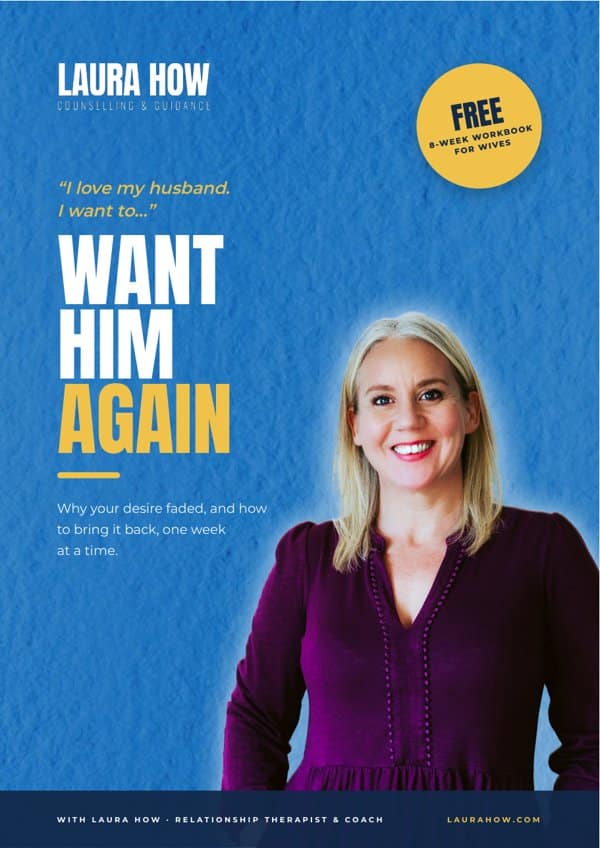
Free 8-week workbook
Bring Back Desire in Your Marriage
Losing desire in a long marriage is common, and it doesn’t mean the love has gone. Want Him Again is my free workbook for wives. It explains why a woman’s desire fades and gives you one simple action a week to bring it back. Written for wives, and well worth reading together.
Thank you! Check your inbox and confirm your email, then your workbook will be on its way.
By entering your email you’re signing up to my monthly newsletter. Unsubscribe any time.
Why Many Sexless Marriages Are Misdiagnosed as Communication Problems
Before we begin, a quick disclaimer: This article does not apply to women who have withdrawn due to trauma, abuse, betrayal, coercion, physical pain or serious relationship problems. Here I’m talking specifically about the far more common, casual withdrawal where the reason is simply “I don’t feel like it.”
When a wife withdraws sexually in a marriage, the usual assumption is that her husband must be failing her somehow, and the proposed solution is almost always the same: strengthen the emotional connection, and sex will follow.
And yes, sometimes that’s true. Yet for a huge group of couples, that advice is completely backwards, and almost no one in my profession is talking about it.
Sometimes the lack of sex is the problem, and no amount of talking is going to fix it.
We all know the cliché: Put a jellybean in a jar every time you have sex before marriage, then remove one every time after. The jar will never empty. For married men, sex with their wives is considered “getting lucky.”
These jokes exist for a reason.
But are these stories really true?
Sadly yes.
Why Sexual Desire Often Declines in Long-Term Relationships
This pattern is so consistent in long-term relationships that researchers have spent decades trying to understand why.
Research by evolutionary psychologist David Buss, who has studied human mating strategies across dozens of cultures, shows that in the early stages of a relationship, women tend to signal sexual availability to secure a partner². The same pattern appears across cultures.
This isn’t conscious “bait and switch” or cynical behaviour, but it is an effective evolutionary strategy.
Once the relationship is secured, however, things begin to change.
A 2019 study published in Archives of Sexual Behaviour followed newlywed couples over time and found that female sexual desire declined significantly, while male desire, on average, did not decline at all³.
UK population data reveals a similar pattern: women in relationships lasting more than a year are roughly twice as likely as men to report a lasting loss of sexual interest⁴.
Does Emotional Distance Cause Sexual Withdrawal, or Does Sexual Withdrawal Come First?
Now, I can already hear some of you thinking: “Yes, but surely that’s because he withdrew emotionally first. He stopped making her feel safe, so she withdrew sexually.”
And yes, sometimes that’s precisely what happened.
But a large-scale study of thousands of newlywed couples showed that improvements in sexual satisfaction predicted future improvements in relationship satisfaction, whereas the reverse was not true⁵.
The same 2019 study went even further, finding that declines in female sexual desire specifically preceded declines in relationship satisfaction for both partners³.
So, when she says he’s become emotionally distant, she may be absolutely right. But the data suggests that in many cases, his emotional withdrawal was a response to her sexual disengagement.
The Hidden Emotional Impact of Sexual Rejection in Marriage
When a man chooses a wife, he does so with the belief that he has finally found a woman who will meet one of his deepest emotional needs: a close, lifelong sexual bond with the woman he loves.
When such an important bond is broken, he naturally interprets it as a sign that she no longer values him.
And because he’s been told, directly or indirectly, that sex is trivial and wanting it makes him shallow, rather than push back, he just goes quiet. And withdraws.
The cultural scaffolding around female sexual withdrawal in marriage is immense. She feels little pressure to justify it, while he risks being labelled selfish, or worse, just for raising the subject. The broader culture, from friends and therapists to daytime TV, reinforces this narrative, assuming his behaviour is the cause rather than examining her withdrawal.
When couples end up in therapy, the therapist, consciously or unconsciously, often aligns with this dynamic. The husband is typically told that if he were more emotionally available, helpful, or patient, she would want sex with him. I’ve even heard major relationship institutions advise men not to mention sex at all for six months to see if that helps.
So, he tries all of it.
The housework.
The flowers.
The emotional connection.
And none of it works.
As far as I can tell, the orthodox treatment for sexless marriages tends to be anything other than sex.
They’re treating the downstream effects, not the actual problem.
Want help with this?
Why Sexless Marriage Advice Often Focuses on the Wrong Problem
Now, for the sake of balance, Buss also found that men pursue a parallel mate-securing strategy: attention, investment, and commitment, which often also declines once the relationship is secured². I’m not denying this parallel exists.
What I mean is that both her sexual withdrawal and his emotional withdrawal are typically examined under the assumption that he’s at fault.
We certainly won’t acknowledge the potential nuances of cause and effect.
Why Women Sometimes Lose Sexual Desire in Marriage
So, why did she withdraw in the first place?
Sometimes, there are legitimate physiological reasons, such as hormonal shifts, poor health, medications, or exhaustion. These deserve proper attention, and I’ve covered them in detail in another article about Why Women Lose Sexual Desire.
But in my clinical experience, the honest truth is often much simpler than that: she simply doesn’t want to and it’s easier not to. And nobody’s going to tell her to reconsider.
In my experience, this attitude rarely stems from cruelty or intentional neglect, but more commonly from a lack of understanding.
She just doesn’t get it. She thinks it’s all a big fuss about nothing. And in a culture that validates female sexual reluctance while pathologising male sexual desire, why would she think otherwise?
On top of that, women, like men, are human beings, and like all human beings they can become apathetic in their relationships. It’s not always that complicated.
The Emotional Cost of Long-Term Sexual Rejection
No man is perfect. But in a monogamous relationship, total sexual withdrawal is a serious thing to do to someone. Nobody gets a year in solitary for stealing an apple. However, more often than not, when examining sexless marriages, I fail to see the crime worthy of such a response.
And the emotional cost to men is enormous. I hear this from clients constantly, men who have tried everything, only to be rejected completely.
One man commented here recently, describing six and a half years without physical intimacy after his wife told him he needed to
“…find something else to focus on to give his life meaning.”
He ended with:
“I’ve kind of given up on most everything now. And yet, I still love her, which makes the hurt even more so.”
Why Understanding What Sex Means to Men Changes Everything
Until women understand the problem, men will be the problem. But as Warren Farrell says, “women can’t hear what men don’t say.”
So, it’s vitally important to get crystal clear on what sexual intimacy truly means, not just the physical act, but the profound emotional connection it represents. The turning point for women is often the moment they realize it’s not about sex in general, but about him feeling emotionally connected to her specifically.
When it’s put that way, more often than not, her heart opens and progress can begin.
I know this might sound like fantasy, but I hear it constantly from women in sessions and from female viewers.
“I had no idea what sex actually meant to my husband. I honestly thought it was just physical release.”
Another wrote:
“I started crying because I realised, he had just been wanting to love me.”
Many women need to be explicitly told how profoundly important a loving sexual connection is to men.
Sexual Communal Strength and the Research on Meeting a Partner’s Sexual Needs
So, if meaning can be communicated, then what next?
One concept from relationship research is sexual communal strength, the motivation to meet your partner’s sexual needs out of genuine care for them and the marriage⁶.
Research shows that women with higher levels of sexual communal strength report greater sexual desire over time, with both partners experiencing higher relationship satisfaction as a result⁶.
Broader research is unambiguous: sexually active marriages significantly outperform sexless ones across virtually every measure of relationship quality and well-being⁷.
But this isn’t the same as simply having sex regardless of how you feel, what researchers call unmitigated sexual communion⁸. That approach doesn’t work and harms both partners.
The key difference is intent: giving from a place of willing generosity, in a marriage that is generally loving.
1-Day Couples Intensive
Is your marriage in crisis?
One focused day with Laura. The depth of 8–10 weekly sessions, with real momentum, and a personalised action plan to take home.
- Morning Discovery
- Afternoon Recovery
- Online or in Somerset
- Action plan within 7 days
Investment £2,250
Can Restoring Sexual Intimacy Repair a Marriage?
If the absence of sex has been poisoning the emotional climate, the most direct path back is to start having sex again, approached as a team, and from a place of genuine care. Care being the operative word. She has to care. If she doesn’t, then the marriage has more problems than sex, but that’s for another article.
For couples where both partners are willing to commit to a period of intentional intimacy, the results are often striking.
More warmth.
More physical touch.
Less tension.
Less conflict.
And a marriage that feels like a marriage again.
How Much Sex Do Healthy Marriages Actually Have?
So how much sex are we actually talking about?
Research suggests once a week is broadly the sweet spot. Couples who have sex at least once a week report significantly higher relationship satisfaction and wellbeing than those who have less⁹.
In my clinical experience, however, couples where the relationship feels genuinely vibrant tend to be closer to two or three times a week. Once a week is a reasonable minimum, not the ceiling.

Women-only community
The Good Wife Club
A warm, women-only community led by Laura How. Somewhere to learn what actually makes a marriage thrive.

Men-only community
The Good Husband Club
A warm, men-only community led by Laura How. Somewhere to learn what actually makes a marriage thrive.
When the Real Problem in Marriage Isn’t Communication, It’s Sex
So many couples spend years trying to solve the wrong problem.
Because a lot of marriages don’t have a communication problem.
And sex is part of a loving marriage, not a reward for one.
Until next week, to yourselves and to others, tell the truth.
Recommended Reading About Intimacy in Marriage

His Needs, Her Needs
‘This book will educate you in the care of your spouse,’ explains Dr Willard Harley. ‘Once you have learned its lessons, your spouse will find you irresistible, a condition that’s essential to a happy and successful marriage.’
This fresh and highly entertaining book identifies the ten most important needs within marriage for husbands and wives. It teaches you how to fulfil each other’s needs. Couples who find each other irresistible during the early years of their marriage may become incompatible if they fail to meet these central needs. According to Dr Harley, the needs of men and women are similar, but their priorities are vastly different.
Are you able to identify which of the following needs are his and which are hers? In what order would you place them? Admiration, Affection, An attractive spouse, Conversation, Domestic support, Family commitment, Financial support, Honesty and openness, Recreational companionship, Sexual fulfilment.

The Passionate Marriage
Passionate Marriage has long been recognized as the pioneering book on intimate human relationships. Now with a new preface by the author, this updated edition explores the ways we can keep passion alive and even reach the height of sexual and emotional fulfillment later in life. Acclaimed psychologist David Schnarch guides couples toward greater intimacy with proven techniques developed in his clinical practice and worldwide workshops. Chapters―covering everything from understanding love relationships to helpful “tools for connections” to keeping the sparks alive years down the road―provide the scaffolding for overcoming sexual and emotional problems. This inspirational book is sure to help couples invigorate their relationships and reach the fullest potential in their love lives.

The Sex-Starved Marriage
Bring the spark back into your bedroom and your relationship with gutsy and effective advice from bestselling author Michele Weiner Davis. It is estimated that one of every three married couples struggles with problems associated with mismatched sexual desire. If you want to stop fighting about sex and revitalize your intimate connection with your spouse, then you need this book. In “The Sex-Starved Marriage,” bestselling author Michele Weiner Davis will help you understand why being complacent or bitter about ho-hum sex might cost you your relationship. Full of moving first-hand accounts from couples who have struggled with the erosion of sexual desire and rebuilt their passionate connection, “The Sex-Starved Marriage” addresses every aspect of the sexual libido problem.
References
- Hogue, J. V., Rosen, N. O., Bockaj, A., Impett, E. A., & Muise, A. (2019). Sexual communal motivation in couples coping with low sexual interest/arousal: Associations with sexual well-being and sexual goals. PLOS ONE, 14(7), e0219768.
https://doi.org/10.1371/journal.pone.0219768
Accessible: https://pmc.ncbi.nlm.nih.gov/articles/PMC6636740/ - Buss, D. M., & Schmitt, D. P. (1993). Sexual strategies theory: An evolutionary perspective on human mating. Psychological Review, 100(2), 204–232.
https://doi.org/10.1037/0033-295X.100.2.204
Accessible: https://pubmed.ncbi.nlm.nih.gov/8483982/ - McNulty, J. K., Maxwell, J. A., Meltzer, A. L., & Baumeister, R. F. (2019). Sex-differentiated changes in sexual desire predict marital dissatisfaction. Archives of Sexual Behavior, 48(8), 2473–2489.
https://doi.org/10.1007/s10508-019-01471-6
Accessible: https://pubmed.ncbi.nlm.nih.gov/31471791/ - Mitchell, K. R., Mercer, C. H., Ploubidis, G. B., Jones, K. G., Datta, J., Field, N., … Wellings, K. (2013). Sexual function in Britain: Findings from the third National Survey of Sexual Attitudes and Lifestyles (Natsal-3). The Lancet, 382(9907), 1817–1829.
https://doi.org/10.1016/S0140-6736(13)62366-1
Accessible: https://pubmed.ncbi.nlm.nih.gov/24286787/ - McNulty, J. K., Wenner, C. A., & Fisher, T. D. (2016). Longitudinal associations among relationship satisfaction, sexual satisfaction, and frequency of sex in early marriage. Archives of Sexual Behavior, 45(1), 85–97.
https://doi.org/10.1007/s10508-014-0444-6
Accessible: https://pmc.ncbi.nlm.nih.gov/articles/PMC4472635/ - Muise, A., & Impett, E. A. (2015). Good, giving, and game: The relationship benefits of communal sexual motivation. Social Psychological and Personality Science, 6(2), 164–172.
https://doi.org/10.1177/1948550614553641
Accessible: https://journals.sagepub.com/doi/abs/10.1177/1948550614553641 - Lodge, A. C., & Umberson, D. (2012). All shook up: Sexuality of mid- to later life married couples. Journal of Marriage and Family, 74(3), 428–443.
https://doi.org/10.1111/j.1741-3737.2012.00969.x
Accessible: https://pmc.ncbi.nlm.nih.gov/articles/PMC3983915/ - Muise, A., Bergeron, S., Impett, E. A., Delisle, I., & Rosen, N. O. (2017). The costs and benefits of sexual communal motivation for couples coping with vulvodynia. Health Psychology, 36(8), 819–827.
https://doi.org/10.1037/hea0000508
Accessible: https://pubmed.ncbi.nlm.nih.gov/28165264/ - Muise, A., Schimmack, U., & Impett, E. A. (2016). Sexual frequency predicts greater well-being, but more is not always better. Social Psychological and Personality Science, 7(4), 295–302.
https://doi.org/10.1177/1948550615616462
Accessible: https://www.emilyimpett.com/s/2016-SPPS-Muise-et-al.pdf
Ready to start?
Book a session with Laura, online worldwide or in person in Somerset.

You’re so interesting! I don’t think I have
read a single thing like that before. So great
to find someone with unique thoughts on this topic. Seriously..
thanks for starting this up. This site is one thing that
is required on the internet, someone with some originality!