

Why This Question Matters
Intimacy after menopause is not over. It’s just changing form.
How do you keep your marriage alive sexually through and after menopause? It’s the question I’m asked more than any other on my channel. And the cultural messaging around it is almost uniformly one of decline, retreat, and resignation. This article pushes back on that, with twenty-plus years of clinical observation and the lived experience of women who’ve come through this transition with their intimacy intact.
Laura How is a UK relationship therapist specialising in sexless marriage and female sexual desire in long-term relationships.
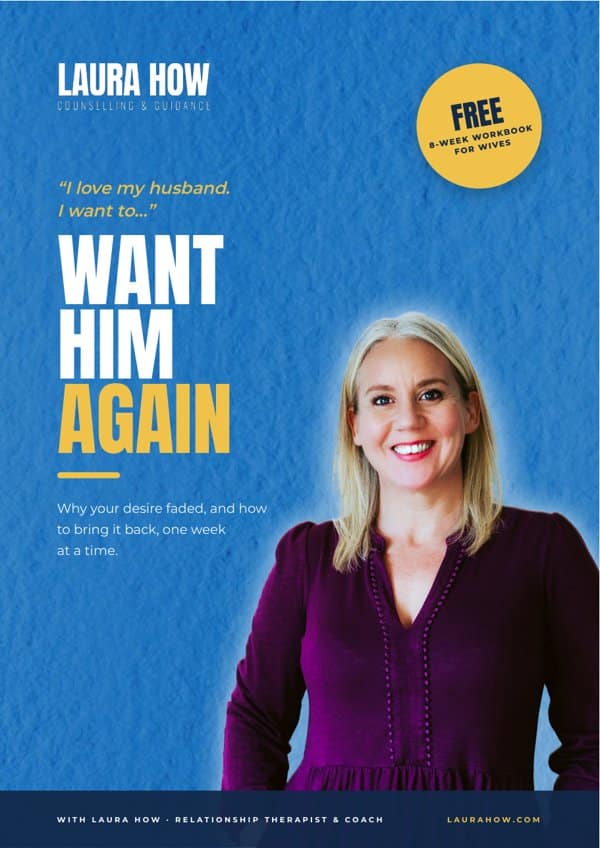
Free 8-week workbook
Bring Back Desire in Your Marriage
Losing desire in a long marriage is common, and it doesn’t mean the love has gone. Want Him Again is my free workbook for wives. It explains why a woman’s desire fades and gives you one simple action a week to bring it back. Written for wives, and well worth reading together.
Thank you! Check your inbox and confirm your email, then your workbook will be on its way.
By entering your email you’re signing up to my monthly newsletter. Unsubscribe any time.
First, a quick disclaimer: this article assumes you’re in a marriage with a safe, kind, and loyal man. Nothing in here argues for sex without enthusiasm, comfort, or genuine connection. The physical realities of menopause are real and treatable, and the relational work is yours to do together.
Menopause Is Just Another Hormonal Transition
Menopause is something I’m in the middle of, so I’m still working it out in real time. But I’ve spent twenty-plus years watching women navigate this transition. Clients and friends who’ve gone through it beautifully, and women like me, who are in the thick of it.
What I’ve learned is that menopause works the same way as every other major hormonal transition. Puberty. Motherhood. The monthly cycle. The principles that get you through them well are the same ones that will help you navigate menopause without letting it take a wrecking ball to your marriage or sex life.
To be clear before we go further: this isn’t about obligation or duty sex. It’s about thriving through menopause with your sensuality, vitality, and an intimate, mutually enjoyable sexual connection with your husband intact.
Libido Is Life Force, Not Just Sex Drive
One of the main symptoms you’ll hear about menopause is reduced libido. But before we talk about that, let’s think about what the word libido really means. Because it’s way bigger than sex drive alone.
Libido, first and foremost, is life force. It’s the spring in your step, the sparkle in your eyes, and the colour in your world. It’s music and dance and humour and play. It’s drive, movement, charge, and motivation.
It’s something you can consciously nurture throughout your life. In fact, great sex in later life comes far more from vitality and curiosity than from physical compulsion.
You can see it clearly in those older women who still have it. Seventy years old, yet vibrant, full of gratitude, playful, and flamboyant. Alive, in every way a woman can be alive.
What Their Secret Is
So what are these women doing well?
They know themselves. They know their rhythms. They know what makes them feel alive and what shuts them down.
And they treat that life force like a delicate flame they hold in their hands. They feed it. They care for it. And they protect it.
The Pillars of Health That Keep Your Libido Alive
What does that look like in practice? For me, my list is fairly specific.
- Good sleep.
- Time outside in nature.
- Real food. No alcohol. No other toxins.
- Financial security.
- No TV or social media.
- Friends I can be authentic with. Time with people who cherish me.
- Self-advocacy.
- Movement. In all the ways I must keep moving. Physically, mentally, emotionally, relationally, and spiritually.
- And underneath all of that, a loving, honest, secure relationship with my husband.
That’s my list. These are the pillars of health that allow my libido to flourish. And probably yours too.
Sex Itself Is Also a Pillar of Health
Sex, or more specifically partnered orgasm, is also a pillar of health. And the research on this is clear.
Orgasm releases tension. It improves mood and sleep. It lowers depression and anxiety. It supports heart health. It sharpens cognitive function. It deepens your bond with your husband.
In fact, women who have regular satisfying sex live longer than women who don’t.
In my experience, it’s also good for your temperament. Women who orgasm regularly appear softer, warmer, and less uptight. We’re lubricated, fluid, and infinitely more emotionally flexible.
In fact, if you’re taking good care of yourself, sex at this age is often better than it used to be. More fun and more relaxed. You might feel more confident, more at home in your own skin, and enjoy a much stronger connection with your husband.
So this isn’t a chore. It’s essential self-care that your body and your marriage need, even if the urge isn’t as strong as it once was.
Want help with this?
Intimacy Is a Health Choice, Not a Spontaneous Impulse
The point is, intimacy in later life isn’t about waiting for a spontaneous impulse to want sex. It’s just not how it works anymore. It has to become a deliberate health choice. One you pursue intentionally, like any other aspect of well-being.
Because sex is to marriage what exercise is to health. Central, not optional. It’s what distinguishes a husband and wife from any other platonic relationship, and what separates a thriving marriage from one that stagnates.
So menopause certainly shouldn’t be an excuse to withdraw from your husband, assuming he’s a safe, kind, and loyal man. It’s just one more situation, like many others, that calls for adaptation and conscious intention.
What’s the Alternative?
What’s the alternative? Giving up sex for the rest of your life because menopause? Never having another orgasm? Avoiding cuddles indefinitely in case they lead to sex? Living like roommates while pretending everything’s okay for the next forty years?
That’s no plan at all. It’s a slow-motion car crash for both of you. One I see playing out week after week in the therapy room.
The alternative is to rise to the challenge. Remain steady throughout. Take responsibility for navigating menopause with grace.
What This Looks Like in My Own Life
In my own life, for example, I’m generally an upbeat, positive woman who truly loves her life and her husband. I cope well with most things and remain steady.
But something happens during my cycle. Sometimes as early as day thirteen now. My outlook suddenly twists and goes dark. I feel emotionally and mentally unsteady, which is deeply unnerving. My husband starts to annoy me. I lose my inclination to work. I feel irritable and overwhelmed, and just want to shut myself in the bedroom or go live in a shack in the woods.
But what I’ve learned when this twist occurs is to double down on the things that sustain me.
Where I might have previously snapped at my husband, I take a walk. Where I might have made a pointed comment to a client, I stay with them and observe. When I want to binge eat garbage, I get to the gym and eat a high protein meal.
If you’re prone to moodiness like I am, allow your husband to gently point it out when he notices. My husband Russ often says to me, “Are you okay? Do you need some space?” My role is to accept that feedback without getting defensive. If we don’t want our loved ones walking on eggshells around us, then we must trust them to voice what we might not see in the moment.
Either way, I tell him what’s going on, and I ask for space and compassion, which he gives. And these measures are soothing. He knows what’s going on, just as I do, and we both understand it’s nobody’s fault. We still make jokes, cuddle, connect, and have sex. No one gets abandoned. There’s just a little more tenderness and a slower pace to all of it.
The point is to keep moving and looking after yourself. Treat it for what it is: a phase in the natural cycle of life, not a crisis that justifies withdrawal.
The Physical Side of Menopause and Intimacy
So that’s the emotional side. Of course, there are also physical changes that impact intimacy. Pain. Dryness. Discomfort during intercourse. Reduced arousal.
The good news is almost all of it is treatable.
But this isn’t my area of expertise, so I’m going to point you towards the women who are doing brilliant clinical work on this right now.
Look up Dr Mary Claire Haver, Dr Kelly Casperson, and Dr Lauren Streicher on YouTube. They’ll explain that pain is treatable, that HRT can be a godsend for many women, that testosterone offers benefits far beyond sex drive, that the cancer fears most of us grew up with are largely outdated, and that you have far more sexual options than you might think if discomfort or pain is an issue.
If you’re considering HRT, one key piece of advice: find a reputable clinic. Don’t settle for a family doctor telling you your results are normal if you don’t feel normal. Ask for a copy of the results, do your own research, and advocate for yourself.
Maiden, Mother, Matriarch
I want to leave you with a spiritual concept. One that I find incredibly helpful.
You’ve probably heard of the maiden, mother, and matriarch archetypes. These describe phases of a woman’s life. The maiden, youthful, playful, and curious. The mother, nurturing, generous, and devoted to those she loves. And the matriarch, wise, grounded, and self-assured.
Most women think they leave each one behind as they go. The maiden dies when motherhood begins. The mother dies when the kids leave home. And the matriarch is all that remains.
But I disagree.
The women who enter midlife and beyond at their most beautiful are those who carry all three archetypes. The maiden, still curious, sexy, and playful. The mother, still caring and generous. And the matriarch, who has finally arrived to embody them both with her wisdom and experience.
That’s a whole woman. Integrated. Complete.
And it has nothing to do with physical youth, perky boobs, or flawless skin.
It’s deeply attractive to your husband, by the way. I hear this all the time in my practice. He doesn’t want a younger version of you. He wants the woman you are now. The one who can still laugh, play, and flirt, who loves and cares fiercely, and who’s grown in wisdom and depth in ways your twenty-five-year-old self never could have.
1-Day Intensive for Women
Ready to want him again?
One focused day with Laura, just for you. Understand what happened to your desire, and leave with a personalised plan to bring it back.
- Morning Discovery
- Afternoon Recovery
- Online or in Somerset
- Action plan within 7 days
Investment £2,250
The Cost of Getting This Wrong
Don’t let menopause take you down. Don’t abandon fun, connection, and play. Don’t leave your husband out in the cold. Don’t become the cliché, angry menopausal Karen who makes everyone’s life a misery. And don’t become the older, lifeless couple you see in restaurants with nothing to say to each other because their bond only exists through law and circumstance.
Find a way through that you can look back on with a sense of achievement. And to do that, you have to put sex where it belongs, at the heart of your marriage.
I am rooting for you all.
THE GOOD WIFE CLUB
A warm, women-only community led by Laura How, relationship coach and host of the Love & Cherish podcast. Somewhere to learn what actually makes a marriage thrive.
➔ Community support with other Good Wife Club members
➔ Laura’s courses and members-only vlogs
➔ Ask Russ, a man’s honest answer when you want one
➔ Premium: live monthly meet with Laura and her video courses
Recommended Reading About Intimacy in Marriage

His Needs, Her Needs
‘This book will educate you in the care of your spouse,’ explains Dr Willard Harley. ‘Once you have learned its lessons, your spouse will find you irresistible, a condition that’s essential to a happy and successful marriage.’
This fresh and highly entertaining book identifies the ten most important needs within marriage for husbands and wives. It teaches you how to fulfil each other’s needs. Couples who find each other irresistible during the early years of their marriage may become incompatible if they fail to meet these central needs. According to Dr Harley, the needs of men and women are similar, but their priorities are vastly different.
Are you able to identify which of the following needs are his and which are hers? In what order would you place them? Admiration, Affection, An attractive spouse, Conversation, Domestic support, Family commitment, Financial support, Honesty and openness, Recreational companionship, Sexual fulfilment.

The Passionate Marriage
Passionate Marriage has long been recognized as the pioneering book on intimate human relationships. Now with a new preface by the author, this updated edition explores the ways we can keep passion alive and even reach the height of sexual and emotional fulfillment later in life. Acclaimed psychologist David Schnarch guides couples toward greater intimacy with proven techniques developed in his clinical practice and worldwide workshops. Chapters―covering everything from understanding love relationships to helpful “tools for connections” to keeping the sparks alive years down the road―provide the scaffolding for overcoming sexual and emotional problems. This inspirational book is sure to help couples invigorate their relationships and reach the fullest potential in their love lives.

The Sex-Starved Marriage
Bring the spark back into your bedroom and your relationship with gutsy and effective advice from bestselling author Michele Weiner Davis. It is estimated that one of every three married couples struggles with problems associated with mismatched sexual desire. If you want to stop fighting about sex and revitalize your intimate connection with your spouse, then you need this book. In “The Sex-Starved Marriage,” bestselling author Michele Weiner Davis will help you understand why being complacent or bitter about ho-hum sex might cost you your relationship. Full of moving first-hand accounts from couples who have struggled with the erosion of sexual desire and rebuilt their passionate connection, “The Sex-Starved Marriage” addresses every aspect of the sexual libido problem.
Ready to start?
Book a session with Laura, online worldwide or in person in Somerset.
