

What It Really Means to Ask for What You Want in Marriage
A relationship therapist on asking for what you want in marriage. How to tell a healthy desire from an emotional wound, how to ask without pressure, how to say no without causing harm, and what a marriage becomes when two people can finally speak freely about what they want, sexually and otherwise.
Laura How is a UK relationship therapist specialising in sexless marriage and sexual desire in long-term relationships.
Free guide
Sexless Marriage:
Why It Happens and How to Rebuild Intimacy
Start here if intimacy has broken down in your marriage.
If intimacy has broken down in your marriage or is disappearing slowly, this is the place to start. Laura covers why it happens, what it does to both partners, and what actually works to fix it.
First, a quick disclaimer: this article is for marriages that feel fundamentally safe, not those involving abuse, coercion or fear. If yours is genuinely unsafe, none of this applies. That is a different conversation, and one I have covered in my emotional safety article.
Is It Okay to Ask for What You Want in Marriage?
Last week I wrote about the fundamental needs of a marriage, and the duty we all have to tend to them. Honesty. Sexual connection. Emotional safety. These belong to the marriage itself, and they are tended jointly, never demanded.
This week, I want to talk about something different. Desires. The self-indulgent, just-for-me treats that are unique to each of you.
It might be a luxurious massage. Oral sex. Your favourite meal cooked for you. A sexual fantasy finally acted out. Or an afternoon to yourself with no responsibilities at all.
What all of these have in common is the request underneath them: can I allow myself to stop giving, just for a while, and be looked after by you?
We work and serve all week. The job, the kids, the house, the bills. These asks are a break from being responsible. A break from doing. Permission to be loved, with nothing expected in return.
So, are you allowed to ask? Yes. For any of it.
But not every ask is a healthy one. The same request can either bring a couple closer or push them apart. And the difference has nothing to do with the request itself. It has everything to do with where it comes from and, crucially, your internal response when the answer is no.
Why Speaking Your Desires Takes Courage
It takes courage to voice a desire. Maybe we do not feel worthy. Maybe there is a wound behind it. Maybe it exposes a vulnerability, or a part of ourselves we have never shared. Yet it is in the asking, and in how we respond to a partner’s request, that we truly come to know who we are.
In this article, I am going to show you what a healthy desire looks like, and what to do if it is not one. How to ask in a way that leaves your partner free to say no. How to say no yourself, without causing harm. And, most importantly, what a marriage becomes when two people can finally speak freely about what they want.
And if you and your partner are still stuck on the bigger stuff, what is a need, what is fair, who is owed what, there is plenty here for you too. Do read on.
Why We Expect Our Partner to Fix Us
James Hollis, in Finding Meaning in the Second Half of Life, says we spend the first half of our lives meeting other people’s expectations, then, in the second, hand our partner a job they never applied for. Finish me. Heal my wounds. Make me feel okay. He calls it the fantasy of the “magical other.”
The magical other does not exist.
Your partner can support your wounds. But they cannot become the treatment for them. Your wounds are yours.
And yet, a good marriage is exactly where the growing and healing happens. Not because your partner fixes you. But because they are the one person who can show you where your work is.
And the work is becoming your own person. Hollis has a word for this. He calls it individuation, becoming a whole person. Not the one your parents needed, or your teachers wanted, or your marriage expects. But your true, authentic self.
What a Whole Person Looks Like in a Relationship
A whole person knows what they feel and what they want, without needing someone else to validate them. They are okay in themselves, and a partner’s love adds to them. It does not prop them up. They are comfortable in their own company, and they can be close to someone without disappearing into them. They can soothe themselves, and they can allow themselves to be soothed.
They know what upsets them, and why. And they do not rely on others to manage their feelings. Their sense of self is not harmed by a rejection, a disagreement, or a bad week.
And they have a meaningful life of their own.
Nobody is ever really complete, of course. We are all human, and we are all fallible. But a whole person is generally standing on their own feet.
How to Become a More Whole Person
So how do you grow, intentionally, toward being more whole?
First, you have to actually want to. And most people never do, because the culture will happily keep you busy and distracted so you never have to look.
But for those who do: start with the body. Sleep. Exercise. Real food. Time outdoors. Give it what it needs, and do not give it what it does not.
Spend time alone. No people, no screens. Because the parts of you that you need to hear will only speak when it is quiet. Solitude is where you meet yourself.
And if something comes up, anxiety, restlessness, grief, turn towards it. Sit with it, reflect, write it down, and if it is too much to make sense of alone, talk to someone. You cannot hide from these wounds and expect to be whole. They will just start running the show without you.
Finally, build a life that is your own, with purpose outside the relationship. Friends you can be honest with. Do something meaningful with your time. Develop a sense of why you are here and where you are going.
None of this is a precondition for expressing desire. You do not have to be whole before you speak. But a relationship can only ever be as healthy as the two people in it, and being as whole as you can be is part of loving well.
Do We Still Need Each Other?
Now, none of this means becoming Buddha, wanting for nothing and needing no one. A whole person still needs closeness. To be held, reassured, wanted and seen. Growing up does not make these human needs go away. But it does mean you will carry them like an adult.
Attachment, our need to bond and connect, does not end when childhood does. John Bowlby, who founded the whole field, said it runs “from the cradle to the grave.” We are attachment beings. It is wired into us, and it is what kept our ancestors alive.
You can see it in toddlers. They venture off to explore, then rush back to mum, then venture a little further, a little braver each time, precisely because mum is there. In the same way, a partner who is a safe base makes you more confident in the world.
So this is what we are building toward. Not a cold, unattainable independence, nor a toxic fusion, but healthy, adult interdependence.
The goal is not to want for nothing. It is to know where the wanting comes from.
Want help with this?
How to Tell a Healthy Desire From an Emotional Wound
So how do you tell a healthy desire from an unhealthy one?
It is almost never about what you are asking for, but much more about where the desire points.
A healthy desire moves toward something good. Toward pleasure, closeness, rest, play or connection. You want the thing because the thing is lovely, and sharing it with the person you love makes it lovelier still. It carries a positive energy.
A wound moves away from something you cannot bear. Away from anxiety, from emptiness, or from a feeling you would do anything not to feel.
Now, to be clear, wanting a treat after a hard week is not running from a wound. The wound’s version is compulsive, and never satisfies. The healthy version tops you up, and that is that.
So the question is not “what do I want?” It is “where is this coming from, and would receiving it actually be enough?”
1-Day Couples Intensive
Is your marriage in crisis?
One focused day with Laura. The depth of 8–10 weekly sessions, with real momentum, and a personalised action plan to take home.
- Morning Discovery
- Afternoon Recovery
- Online or in Somerset
- Action plan within 7 days
Investment £2,250
What a Healthy Sexual Request Looks Like
So what does a healthy request actually look like?
A healthy ask is light, and it carries nothing but itself.
If the answer is no, the asker survives. No harm, no foul, no drama. Disappointment, maybe, of course. But the desire just waits for another day, because an offering can be declined without the world ending.
And a light ask like that is a gift to receive. An invitation to delight someone you love, and they are completely free to accept or decline. That freedom is what makes the giving feel like love, rather than a chore.
But there is another kind of ask. One that comes from a wound, and carries a heavier, darker energy.
The hovering. Circling the subject for days before daring to raise it. Testing the mood first. The pre-apology. The sheer gravity of what a rejection might mean to the self.
And whilst this is usually fear rather than manipulation, it is not the approach of a whole person, and it just does not work. It puts your partner in charge of your emotional state, so every ask becomes a test they can fail.
So it is not the request. It is the energy behind it.
What a “No” Reveals About Your Desire
So how do you know, honestly, which kind of ask is yours? Whether your desire is coming from a healthy place, or not?
If your partner says not tonight, and you feel disappointed, then recover, knowing you can ask again another time, your desire is healthy.
But if a no sends you into a spiral, where you sulk, shut down, or add it to the mental tally of every other time they have let you down, then the desire was never really about the thing. It was hiding a wound.
This, as painful as it feels, is a gift, because it shows you where your work is.
And just to be clear, this does not mean “stop asking until you are fixed.” You do not have to earn the right to want things.
What changes is where you take the pain underneath. Because that pain is yours to carry.
But address it you must, because the one thing you cannot do is nothing. You cannot just ask again with a calmer face while your inner world is still torn and twisted. That is avoidance, and it will not get you anywhere.
Sometimes it is enough to honestly name it:
“That was not really about him. He is working hard too. He could do with some down time himself. That was my old fear of not mattering.”
Naming it is sometimes enough to loosen its grip. Other times you will need to go deeper. Read, reflect, talk it through with someone you trust, spend some time alone with it. And if it runs deep, find a good therapist. But do the work.
And none of this means disappearing into a black hole while you do it. Closeness and transparency with your partner are part of the healing. You are just no longer handing them a job that was never theirs to do.
How to Receive a Partner’s Request
On the other side of the equation is the receiver, and being the receiver takes just as much wholeness as being the asker.
Because a whole person can hear a desire they do not share, or cannot meet, or find a bit much, without being disturbed by it. The request does not threaten them, so they do not need to attack it.
And if you notice that a healthy ask does disturb you, if a gentle request lands like an accusation, that is worth sitting with too. The same rules apply. That reaction is yours to understand, not theirs to tiptoe around.
The receiver’s job is simply to meet a healthy ask, with a clear yes, a kind no, or an honest not yet, without causing harm. And that takes a grown-up, too.
Do You Have to Say Yes to Your Partner?
No. Nobody is ever obliged to say yes to someone else’s desires. Your body is yours. Your energy is yours. These are the just-for-me treats we are talking about, the gifts, the extras. They are not what you signed up for as part of the marital covenant.
But freedom from obligation is not the same as freedom from responsibility. You may not owe a yes, but you still owe honesty, kindness, and a willingness to talk if the same thing keeps coming up.
The more interesting question is this: when someone you love tells you what would delight them, do you feel a pull to please them?
The particular thing might be a hard no for you. But that does not mean the pull is gone. You can have no wish to do the thing itself, and still very much want to please them another way.
But if the pull has gone altogether, if you feel nothing at the thought of pleasing them, if their wanting just irritates you, then that is worth paying attention to. Not because you owe them a yes, but because something between you may need working on.
How to Say No Without Hurting Your Partner
First, if an ask is heavy with pressure, or the sense that a no will have consequences, that is a demand, not a request. And it can be perfectly healthy to decline a demand. If, on the other hand, the ask is healthy and the honest answer is still no, then the rule is simple: decline the thing, not the person.
A desire, remember, is someone showing you a piece of who they are. So, a no is about two things: the thing itself, and the person who had the courage to speak. You can turn down the thing while completely honouring the person.
There are, roughly, three kinds of no.
There is the soft no, not right now. “I would love to, just not tonight, I am exhausted.” “How about this weekend?” This is a deferral, not a rejection, and you get to name when.
Then there is the graduated no, not that, but maybe this. Some desires are woven deeply into who your partner is, so the ask is often less about the exact thing than the part of them it speaks to. You may not be able to meet it exactly, but you can lean in with curiosity, ask what it really represents, and move toward that. “I am not comfortable with that right now, but I can see how much it matters to you. Maybe we could try this instead. How would that feel?”
And there is the hard no, not that, not ever. Some things are a genuine limit, and a hard limit is perfectly okay. But even here, you can hold the person tenderly while you decline. “I am sorry, that is not something I will ever be comfortable with. But I am really honoured you felt safe enough to tell me.”
Whatever the no, be honest about the reason. Because a vague or half-true no leaves your partner guessing. “I am just tired.” “Maybe another day,” with no follow-up. Or “I am too busy,” from someone with plenty of time for everything else. That kind of no does not sound like honesty. It sounds like “you do not matter.” And it is kinder to let someone grieve an honest no than to leave them guessing.
How to Say Yes and Mean It
Now the happier one. You are comfortable with the ask, you were free to say no, and you want to say yes. “Yes, I would love to do that for you.”
There is really only one thing to get right here: own it as your own decision, and follow through generously.
Because an empty or grudging yes is just a no in disguise. So do not say yes unless you mean it, and mean it if you do.
The Two Rules of Healthy Communication
If you take nothing else from this article, take these two rules. One for each of you.
If you are the one asking: you must not punish the no. However much it stings, a no is allowed. The moment you make your partner pay for it, you have turned a desire into a demand, and you have taught them that saying no to you is not safe.
And if you are the one answering: you must not punish the ask. You can decline the thing, but you should never make them feel foolish for having wanted it. The eye-roll. The heavy sigh. The moment you shame your partner’s desire is the moment they stop showing you who they are.
Individuation and Attachment: The Two Truths of a Marriage
What I am really describing here, in essence, is the beautiful marriage of two truths.
We are saying yes to becoming more whole. To the lifelong, inside job of individuation. To knowing yourself, healing your own wounds, and standing on your own feet.
At the same time, we are saying yes to attachment. To the deep human need for connection, reassurance, and to be truly known.
And this is why desires matter so much. Because a desire, spoken out loud, reveals something true about you, and it puts that truth in someone else’s hands.
In the asking, you come to understand yourself, and in the receiving, you come to understand your partner. Sometimes what is revealed is an old wound that needs attention. Sometimes it is simply an invitation to delight the person you love.
Real intimacy is built here. In the courage to speak, and in the freedom to answer honestly. And, ultimately, in the repairs, when we get it wrong.
Wherever it leads, to work or to delight, a spoken desire, at its heart, is always an invitation to be known.
Take the Work Further
If you’d like some support putting this into practice — finding the words, or untangling what’s built up between you — that’s exactly what the Good Wife Club and the Good Husband Club are for. A monthly live call with me on Premium, and a group of people building the same kind of marriage. From $29 a month.
THE GOOD WIFE CLUB
A warm, women-only community led by Laura How, relationship coach and host of the Love & Cherish podcast. Somewhere to learn what actually makes a marriage thrive.
➔ Community support with other Good Wife Club members
➔ Laura’s courses and members-only vlogs
➔ Ask Russ, a man’s honest answer when you want one
➔ Premium: live monthly meet with Laura and her video courses
THE GOOD HUSBAND CLUB
A warm, men-only community led by Laura How, relationship coach and host of the Love & Cherish podcast. Somewhere to learn what actually makes a marriage thrive.
➔ Community support with other Good Husband Club members
➔ Laura’s courses and members-only vlogs
➔ Monthly live peer support meet with Russ
➔ Premium: live monthly meet with Laura and her video courses
And if you found this article helpful, you might also enjoy last week’s, on why your spouse’s needs are your responsibility, where I explain the difference between the needs of a marriage and the desires within it.
Let me know your thoughts in the comments.
In the meantime, to yourself and to others, tell the truth.
Recommended Reading About Intimacy in Marriage

His Needs, Her Needs
‘This book will educate you in the care of your spouse,’ explains Dr Willard Harley. ‘Once you have learned its lessons, your spouse will find you irresistible, a condition that’s essential to a happy and successful marriage.’
This fresh and highly entertaining book identifies the ten most important needs within marriage for husbands and wives. It teaches you how to fulfil each other’s needs. Couples who find each other irresistible during the early years of their marriage may become incompatible if they fail to meet these central needs. According to Dr Harley, the needs of men and women are similar, but their priorities are vastly different.
Are you able to identify which of the following needs are his and which are hers? In what order would you place them? Admiration, Affection, An attractive spouse, Conversation, Domestic support, Family commitment, Financial support, Honesty and openness, Recreational companionship, Sexual fulfilment.

The Passionate Marriage
Passionate Marriage has long been recognized as the pioneering book on intimate human relationships. Now with a new preface by the author, this updated edition explores the ways we can keep passion alive and even reach the height of sexual and emotional fulfillment later in life. Acclaimed psychologist David Schnarch guides couples toward greater intimacy with proven techniques developed in his clinical practice and worldwide workshops. Chapters―covering everything from understanding love relationships to helpful “tools for connections” to keeping the sparks alive years down the road―provide the scaffolding for overcoming sexual and emotional problems. This inspirational book is sure to help couples invigorate their relationships and reach the fullest potential in their love lives.

The Sex-Starved Marriage
Bring the spark back into your bedroom and your relationship with gutsy and effective advice from bestselling author Michele Weiner Davis. It is estimated that one of every three married couples struggles with problems associated with mismatched sexual desire. If you want to stop fighting about sex and revitalize your intimate connection with your spouse, then you need this book. In “The Sex-Starved Marriage,” bestselling author Michele Weiner Davis will help you understand why being complacent or bitter about ho-hum sex might cost you your relationship. Full of moving first-hand accounts from couples who have struggled with the erosion of sexual desire and rebuilt their passionate connection, “The Sex-Starved Marriage” addresses every aspect of the sexual libido problem.

She Comes First
As women everywhere will attest, men are “ill-cliterate.” But in the pages of She Comes First, the mystery of female satisfaction is solved, and the tongue is proven mightier than the sword. According to Ian Kerner–sex therapist and evangelist of the female orgasm–oral sex isn’t just foreplay, it’s coreplay, and is simply the best way to lead a woman through the entire process of arousal time and time again.
Fun and informative, She Comes First is an encyclopedia of female pleasure, detailing dozens of tried-and-true techniques for consistently satisfying a woman and ensuring mutual sexual fulfillment.
Come as You Are
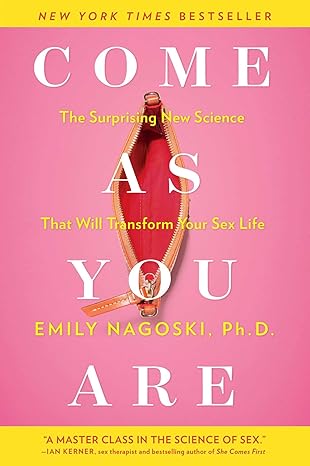
Researchers have spent the last decade trying to develop a “pink pill” for women to function like Viagra does for men. So where is it? Well, for reasons this book makes crystal clear, that pill will never be the answer–but as a result of the research that’s gone into it, scientists in the last few years have learned more about how women’s sexuality works than we ever thought possible, and Come as You Are explains it all.
Cutting-edge research across multiple disciplines tells us that the most important factor for women in creating and sustaining a fulfilling sex life, is not what you do in bed or how you do it, but how you feel about it. Which means that stress, mood, trust, and body image are not peripheral factors in a woman’s sexual wellbeing; they are central to it. Once you understand these factors, and how to influence them, you can create for yourself better sex and more profound pleasure than you ever thought possible.

Passionista
In the smash hit She Comes First, Ian Kerner singlehandedly waged battle against male sexual “ill-cliteracy,” and women everywhere benefited from his “viva la vulva” philosophy of female pleasure. Now, in Passionista, it’s time to learn all about what turns men onand makes them stay on. In this point-by-point, “blow-by-blow” guide, Kerner makes giving as much fun as receiving as he covers every angle of male sexuality, unlocks the secrets of satisfaction, and offers knowledgeable answers to the questions every woman wonders about. His advice is the closest you’ll ever come to waking up in a guy’s skin and knowing what truly makes him sexually tick.
Ready to start?
Book a session with Laura, online worldwide or in person in Somerset.
