

Why an Avoidant Wife Pulls Away From Intimacy, and How to Reach Her
A relationship therapist on being married to a sexually avoidant wife. Why avoidant attachment in marriage shuts down affection and sex, where the attachment wound comes from, the difference between a dismissive avoidant and a fearful avoidant, how to talk to her without triggering her, what you can reasonably ask of her, and how a marriage reaches earned security.
Laura How is a UK relationship therapist specialising in sexless marriage and sexual desire in long-term relationships.
Sexless Marriage: Why It Happens and How to Rebuild Intimacy
Start here if intimacy has broken down in your marriage.
If intimacy has broken down in your marriage or is disappearing slowly, this is the place to start. Laura covers why it happens, what it does to both partners, and what actually works to fix it.
First, a quick disclaimer: this article is for men who are genuinely safe, faithful and kind. If that is not you, this article is not for you. And it goes without saying, none of this applies to marriages affected by abuse or coercion. That is a different conversation, and one I have covered in my emotional safety article.
And many of the behaviours I describe could point to a number of other legitimate reasons for withdrawal — physical, medical, or something in the marriage itself. So, while this article is about avoidant attachment, it is not a diagnosis tool for it.
Signs of a Sexually Avoidant Wife
The avoidant wife is not cold with everyone. She hugs her friends, she fusses the dog, she strokes your child’s hair while they watch TV. There is plenty of warmth for everyone else, just none for you.
- You go to kiss her mouth, and you get the cheek.
- You reach for a hug, and a quick pat on the back tells you that is enough.
- You place a hand on her back as she passes, and she does not even notice.
- She no longer likes being flirted with, and innuendo or sexual jokes fall flat. Any physical affection feels platonic and forced.
- Sex, if it happens, rarely involves kissing, eye contact, or any apparent interest in your experience. She rarely, if ever, initiates, and she has no interest in hearing about your desires.
And it is not only about physical intimacy. If you are ill, or knocked sideways by something, she is unlikely to sit with you and hold your hand. She will do what needs doing, whilst being irritated that she has to. But other than that, you are on your own.
And when you try to talk about any of it, she gets angry, flustered or overwhelmed. And guess what? It is your fault.
To make matters more confusing, you have noticed that the more attentive you become, the harder you try to show her you are someone worth wanting, the further she pulls away.
So, eventually you stop feeling welcome in your own home. Maybe you swing from angry frustration to complete withdrawal. And while you know it is making things worse, you just do not know how to cope.
Resentment sets in both ways and the distance grows. You wonder whether she even likes you, let alone wants to be married to you, to the extent that being warm and affectionate now feels like a form of self-betrayal.
Sound familiar?
Why Your Wife Avoids Intimacy: Fear, Not Rejection
OK. So, assuming there are no other obvious factors at play, why on earth would someone who married you apparently feel such little regard for your needs?
The first thing to hammer home here is that we are dealing with someone who has been wounded, not someone who is cruel. And this is a critical distinction that needs to be held from here on in.
People talk about attachment theory like it is some cute little label. It is not. It can be debilitating, and it can devastate a marriage.
Getting angry with an avoidant wife about sex is like shouting at someone with a phobia. It is not about sex. It is about fear.
So let me show you where that comes from.
The Two Types of Avoidant Attachment in Women
Avoidant attachment usually forms in childhood, in homes where reaching out for connection was either futile or dangerous. There are two types.
The Dismissive Avoidant Wife
The dismissive avoidant grew up in a home where nobody came when she called. A caregiver who was distracted, or distant, or uncomfortable being clung to.
Picture a little girl who stops crying because nobody comes, and then gets praised for being such a good, quiet girl. She learned, very early, that having needs was something to suppress. So she does not reach for intimacy, because she stopped expecting it a long time ago.
The Fearful Avoidant Wife
The fearful avoidant grew up somewhere less predictable. A caregiver who was angry, chaotic, or frightening.
Picture a small girl who runs to her mother and then stops herself, because she is frightened of the consequences. She learned, very early, that needing people was not safe. She craves closeness but cannot tolerate it. She comes near, then pulls away.
Why an Avoidant Wife’s Behaviour Is Not About You
What is important to understand here is that none of this is malice, and there is no intent to diminish you. Somewhere inside her is the little girl who learned that needing anything at all was dangerous and painful. So, when your needs show up, they feel the same way hers used to. As a threat.
Being increasingly needed, relied on, or required is the thing she has spent her whole life avoiding. Which explains why the closer you got — moving in, the wedding, the first baby — the more distance she needed.
And none of it is personal. That origin story predates you by twenty years or more. You are just living with the consequences.
And on some level, she knows. She knows what she is not giving you. But what she feels is shame, far more so than motivation to connect. And she will do anything to avoid the shame.
Which is why every conversation you have ever had about this went the way it did. You came to her with your pain, hoping she would understand and move toward you. But what she heard was more proof that she is failing.
She is not trying to hurt you. She is stuck.
What a Sexless, Avoidant Marriage Does to a Husband
Maybe you have not had so much as a hand on your shoulder in six months, let alone any meaningful intimacy. Maybe you have accepted that this is your life now. Maybe you have tried everything in your power, over and over, only to be pushed further and further away.
It is normal to feel grief, confusion, anger and despair. That is your attachment system ringing the alarm for something it desperately needs — to feel wanted, valued and seen. So allow yourself those feelings.
Maybe you have spent years wondering whether you were attractive enough, or successful enough, or patient enough, or loving enough. But let me be clear.
Her attachment wound is not evidence that you are not worth loving.
Can an Avoidant Wife Change? Earned Security Explained
What you need to understand now is that your situation, however desperate it might feel, is not hopeless. Attachment styles are not carved in stone. People can and do become secure. There is a name for it, earned security, and it is well documented. I have watched it happen, in my own marriage and in others.
But it is going to take some work, by both of you. So, let us look at where to start.
Part One: How to Become a Safe Partner for an Avoidant Wife
Here is the principle behind everything I am about to say. What made her this way was danger, unavailability and unpredictability. So, what heals her will be the exact opposite.
Safety, availability and predictability.
Her job will be to move into that space. Yours is to create it.
So I am going to ask you to look past what looks like coldness, and find the lonely, frightened little girl who needs to keep everyone at arm’s length. Because that is who you are going to be speaking to.
It would be wise to educate yourself. Read about attachment. Why Love Matters by Sue Gerhardt would be a great start. And ask her about her childhood if you do not already have a clear picture. Because once you really understand what is going on for her, at her core, you will be a lot less affected by her behaviour. You will start reacting with curiosity instead of panic, and you will stop reading every rejection as a verdict on you.
The Two Reactions That Make Avoidance Worse
Because right now, there is a good chance you are responding to all this in one of two ways, and both of them, without meaning to, are making it worse.
At one end is the anxious response. Crowding, hovering, reading her moods, tiptoeing, sending videos, dropping hints, outright verbal pressure.
At the other is the avoidant response. Sighing, sulking, stonewalling, acting fine when you are not, or complete emotional abandonment.
Both tell her the same thing — this person is not safe. And healing an attachment wound simply is not possible where threat is present. Any threat at all.
And besides that, keeping up either one is exhausting for you too.
What you need to do is settle in the middle. And that does not mean making yourself smaller. Quite the opposite in fact. It means making yourself clearer. The same man, showing up the same way, day after day, without shame and without judgement.
And all of that is a great deal easier if you are building a life that does not orbit her, with your own friends, your own interests, and your own purpose.
I do not need to tell you how painful this is to live with, so if you are struggling with your feelings, talk them through with someone. Either a good therapist, or a trusted friend. And if what you are feeling has gone past loneliness into something flatter and darker, please take that seriously and get proper help as soon as you can, regardless of what happens in your marriage. Your wellbeing needs to be a priority, so look after your physical health too.
But never stop telling the truth in your marriage. Easing off does not mean self-censoring or swallowing your feelings. This is your life too, and a marriage should be sexual, so you have a right to talk about it if it is not.
1-Day Couples Intensive
Is your marriage in crisis?
One focused day with Laura. The depth of 8–10 weekly sessions, with real momentum, and a personalised action plan to take home.
- Morning Discovery
- Afternoon Recovery
- Online or in Somerset
- Action plan within 7 days
Investment £2,250
Part Two: How to Talk to a Sexually Avoidant Wife
Now, how you speak matters more than anything else.
In fact, a 2013 study observed 180 couples having a conversation where one of them wanted the other to change something. Most of the avoidant partners got angry and withdrew, but not all of them. And the ones who stayed engaged had partners who did two things differently:
- They protected her autonomy.
- They made it clear she was valued.
So keep those two things in mind whenever you talk to her.
And talk about your feelings rather than her failings. So,
“I feel lonely.” “I feel frustrated.” Never “you always”, “you never”, or “you are making me feel”.
This does not mean walking on eggshells. If you are at your wits’ end, you owe it to your marriage to say so.
“I am bored.” “This is not normal.” “This is not what I want for my life.” “I cannot live like this forever.”
All of those things were said, and meant, by both of us in my marriage. And they needed to be heard, no matter how much they hurt at the time.
You are not demanding anything of her, but you are telling the truth about your own life. And that is completely acceptable.
You might want to consider something like this:
“I love you. I have been reading about attachment, and I think we have a problem. I want our marriage to work, and I am doing my work, but I cannot see it working unless you do yours too.”
When to Have the Conversation, and When Not To
Timing the conversation is important. Never have these conversations in bed, at bedtime, or after a rejection. You will be frustrated, she will be feeling vulnerable, and you will just end up fighting.
Instead, talk while you are both relatively calm and free of distractions. Maybe even while walking, or driving, or washing up, because it does not always need the intensity of face to face.
And when you do talk, say your piece, and only say it once. An anxious partner might find repetition reassuring, but an avoidant one will just feel it as pressure. So do not demand an answer there and then, say your thing, and then leave it alone. And if it goes badly and she walks out of the room, let her go. She might just need to sit with it and digest it in her own time.
But more important than getting anywhere in the conversation is showing her that you notice, and care about, how she is doing.
So if she is visibly struggling, you might say,
“I can see this is really hard for you right now. What do you need?” And she might say, “I need to not be having this conversation.” And you can say, “All right. Let us go for a walk and talk about something else instead.”
You still get to say what you came to say, but you let her time out when she has had enough.
And the same applies to you. Do not lose your cool. The moment you feel flooded — the moment you want to raise your voice or say something you will regret — that is when you need to take a timeout yourself.
A calm conversation in small doses beats a marathon row any day.
How to Handle Day-to-Day Sexual Rejection
When it comes to the day-to-day rejections, name them as they happen, rather than letting them build into a tally of resentments. If you lean in for a kiss and she snaps her head away, you can say “that hurt”, without a big scene, and then move on.
And if most of your physical affection has come with a hope that it leads to something more, make it clear that pressure is gone. If you want to hug her, tell her you want a hug and nothing more.
Because what we are doing here is taking the pressure out of every interaction, physical or verbal, rather than leading her somewhere she is not yet able to go.
Part Three: What You Can Reasonably Ask of an Avoidant Wife
OK. So you cannot live like this forever. What can you actually ask of her?
Because yes, she is frightened, but frightened does not mean exempt. If nobody ever asks her for anything, nothing changes, and you will both still be here in ten years.
One: Ask Her to Treat Her Attachment Wound
The first thing to ask is that she gets some help of her own. Specialist attachment therapy would be a good place to start, particularly if she has never had the chance to make proper sense of her own story.
Although I have to say, talking was not enough to heal my attachment wounds. I could describe my childhood beautifully and still walk out of the room exactly as afraid as I went in. What actually worked for me was getting out of my head and into my body — road riding, and hiking in nature. It is very hard to stay hyper-aroused after three hours on a bike.
So, suggest anything at all that gets her into her body. Somatic work, running, climbing. Anything that turns the volume down on a nervous system that has been redlining since she was small. And that includes looking honestly at whatever might be keeping it turned up or dulling it down. Drinking, shopping, hours on her phone, or whatever else she is using to cope.
These are fair things to ask. An attachment wound harms a marriage, and asking your wife to treat it is no different from asking a drinker to deal with their drinking.
Two: Ask Her to Approach What Frightens Her
The second thing is that she starts to approach the thing that frightens her. Because nobody ever got over a phobia by avoiding what scares them.
And this is all on a scale, so pitch it where your marriage actually is.
If there is no sex at all, and not much touch either. Maybe she suffered more serious trauma. So you would want to start very small. Fully clothed. Ten minutes of contact that goes nowhere. Sensate focus is designed for exactly that. Structured, progressive touch exercises at a pace she can manage. Look into it together and ask if she would be willing to try.
If there is occasional sex, but it is lacking in intimacy. No kissing, no passion, no warmth. If that is your marriage, then say you would enjoy longer kisses, more involvement in bed, and more affection day to day. As an invitation, not a demand.
The point is that the ask is always to progress to the next step, not the final destination.
And you are just asking her to initiate whatever that next step is. It might be a hand on your back as she passes, or it might be her starting sex herself, rather than waiting for you to ask.
She chooses the moment, and she chooses what it is — but it has to stretch her slightly, or it is not doing anything.
Three: Ask Her to Keep the Conversation Open
And the third thing is that she keeps the conversation open, because a marriage where you cannot discuss the marriage is not a functional one. So, schedule proper check-ins, where you both get to say how it is going and what you are each working on. Weekly at least. Talk about the big things there, and then leave the rest of the week pressure free. But insist they happen.
And this might be a challenge for you too, of course. Research consistently shows that insecurely attached people tend to pair up with one another. So, there is a very good chance that you might be avoidant in some area too. Possibly conflict, difficult conversations, or complex feelings.
So check-ins go both ways, each of you stretching towards the other.
What you must not do with check-ins is turn them into a grievance session, because she will come to dread them, and sooner or later she will find a reason not to be there. Remember, she is already carrying far more shame about this than you realise, so a weekly reminder of her failings will just shut her down.
So, use that time to say what is going well.
“I really appreciated that hug in the kitchen on Tuesday.” “Thank you for initiating on Saturday, it felt lovely to be wanted.”
Be honest about the hard things when they need saying, of course. But let gratitude do most of the talking, because it reassures her that she is valued and appreciated wherever she is on her journey.
The Gottmans recommend five positive interactions for each negative one, and to my mind, that includes during check-ins.
What If She Refuses to Try?
And you are allowed to expect to see some movement. She can go at her own pace, but she does have to move. Just measure it by incremental progress, not perfection.
And if she will not? If you do everything in this article and she refuses even to try, then at some point you will have a decision to make about what you can live with. I hope you never get there. But you are allowed to have a limit, and she is allowed to know what it is.
Our Story: Healing Attachment Wounds in Our Own Marriage
My husband and I have been through our own version of all this, at the extreme end of it at times. Him asking for sex, or me asking him to be more trustworthy, used to send the other into a spiral. Two good people, both hurting and both starving for something the other seemed incapable of giving.
What changed was that we stopped seeing each other as bad, or broken, and developed compassion for the wounds we were both carrying. We stopped being angry with each other and chose to understand one another instead.
What is this? Where does it come from? I love you. I do not want to hurt you. What do you need?
We identified our own patterns and read everything we could get our hands on. Gottman, Sue Johnson, Deida, Willard Harley, Robert Glover. And Healing Sex by Staci Haines. We listened to audiobooks together at bedtime and discussed what we were learning during the day.
We stopped orbiting each other and gave one another space to grow as individuals. He bought me a road bike, and I put the miles in whilst he hit the gym. We spent time alone, to learn, to introspect and to grow.
Eventually, as we became more regulated, we could say what we wanted, and the other could simply hear it.
We came to trust that we both wanted the best for each other, and that when either of us reached out, it was not to take or to diminish, but to connect and to know.
What Intimacy Becomes Once You Both Feel Safe
And that is only the beginning of it.
Once you create a secure attachment in a stable marriage, once you stop fearing intimacy and discover the profound healing benefits of it, emotional and sexual, you can fully relax into needing and being needed. And from here, the focus becomes mutual generosity, abundance and pleasure.
And that is when sex becomes what it was always meant to be. A shared adventure pursued hand in hand. Where everything you have built together is expressed through the body, skin to skin. A place where you can heal, grow, forgive, find courage, be vulnerable, play, and be known in a way nothing else can match.
That so many couples never get there is a genuine tragedy. And it is why I promote the essential nature of sexual connection the way I do.
But you cannot get there while either of you is carrying unhealed wounds. You just cannot. You cannot force it or fake it, demand it or hide from it. Which is why this work matters so much. And it is work every couple should do, attachment problems or not.
I am not telling you any of this because I think we are special. I am telling you because we are not. If we could do it, from where we started, then so can you.
Work with Us
If you need some support with any of the topics raised in today’s article, you can reach out to me or my team and we will be happy to help you.
Take the Work Further
If you’d like some support putting this into practice — finding the words, or untangling what’s built up between you — that’s exactly what the Good Wife Club and the Good Husband Club are for. A monthly live call with me, a private space to ask your questions, and a group of people building the same kind of marriage. $29 a month, or $299 for the year.
THE GOOD WIFE CLUB
A warm, women-only community led by Laura How, relationship coach and host of the Love & Cherish podcast. Somewhere to learn what actually makes a marriage thrive.
➔ Monthly live group meet with Laura (4th Friday, 6.30pm UK)
➔ A private space to ask Laura your questions
➔ Community support with other Good Wife Club members
➔ Companion notes from Laura’s videos
➔ New exclusive videos regularly added
➔ First access to new courses, intensives and events as they open

THE GOOD HUSBAND CLUB
A warm, men-only community led by Laura How, relationship coach and host of the Love & Cherish podcast. Somewhere to learn what actually makes a marriage thrive.
➔ Monthly live group meet with Laura (2nd Friday, 6.30pm UK)
➔ A private space to ask Laura your questions
➔ Community support with other Good Husband Club members
➔ Companion notes from Laura’s videos
➔ New exclusive videos regularly added
➔ First access to new courses, intensives and events as they open
And if you found this article helpful, you might also enjoy my ten rules for marriage.
Let me know your thoughts in the comments.
In the meantime, to yourself and to others, tell the truth.
Recommended Reading About Intimacy in Marriage

His Needs, Her Needs
‘This book will educate you in the care of your spouse,’ explains Dr Willard Harley. ‘Once you have learned its lessons, your spouse will find you irresistible, a condition that’s essential to a happy and successful marriage.’
This fresh and highly entertaining book identifies the ten most important needs within marriage for husbands and wives. It teaches you how to fulfil each other’s needs. Couples who find each other irresistible during the early years of their marriage may become incompatible if they fail to meet these central needs. According to Dr Harley, the needs of men and women are similar, but their priorities are vastly different.
Are you able to identify which of the following needs are his and which are hers? In what order would you place them? Admiration, Affection, An attractive spouse, Conversation, Domestic support, Family commitment, Financial support, Honesty and openness, Recreational companionship, Sexual fulfilment.

The Passionate Marriage
Passionate Marriage has long been recognized as the pioneering book on intimate human relationships. Now with a new preface by the author, this updated edition explores the ways we can keep passion alive and even reach the height of sexual and emotional fulfillment later in life. Acclaimed psychologist David Schnarch guides couples toward greater intimacy with proven techniques developed in his clinical practice and worldwide workshops. Chapters―covering everything from understanding love relationships to helpful “tools for connections” to keeping the sparks alive years down the road―provide the scaffolding for overcoming sexual and emotional problems. This inspirational book is sure to help couples invigorate their relationships and reach the fullest potential in their love lives.

The Sex-Starved Marriage
Bring the spark back into your bedroom and your relationship with gutsy and effective advice from bestselling author Michele Weiner Davis. It is estimated that one of every three married couples struggles with problems associated with mismatched sexual desire. If you want to stop fighting about sex and revitalize your intimate connection with your spouse, then you need this book. In “The Sex-Starved Marriage,” bestselling author Michele Weiner Davis will help you understand why being complacent or bitter about ho-hum sex might cost you your relationship. Full of moving first-hand accounts from couples who have struggled with the erosion of sexual desire and rebuilt their passionate connection, “The Sex-Starved Marriage” addresses every aspect of the sexual libido problem.

She Comes First
As women everywhere will attest, men are “ill-cliterate.” But in the pages of She Comes First, the mystery of female satisfaction is solved, and the tongue is proven mightier than the sword. According to Ian Kerner–sex therapist and evangelist of the female orgasm–oral sex isn’t just foreplay, it’s coreplay, and is simply the best way to lead a woman through the entire process of arousal time and time again.
Fun and informative, She Comes First is an encyclopedia of female pleasure, detailing dozens of tried-and-true techniques for consistently satisfying a woman and ensuring mutual sexual fulfillment.
Come as You Are
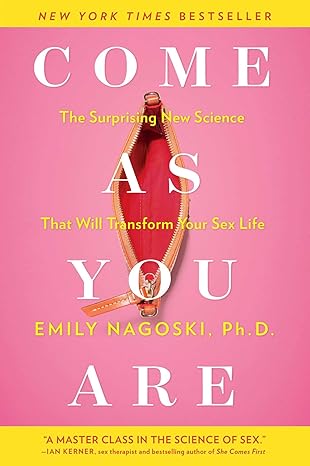
Researchers have spent the last decade trying to develop a “pink pill” for women to function like Viagra does for men. So where is it? Well, for reasons this book makes crystal clear, that pill will never be the answer–but as a result of the research that’s gone into it, scientists in the last few years have learned more about how women’s sexuality works than we ever thought possible, and Come as You Are explains it all.
Cutting-edge research across multiple disciplines tells us that the most important factor for women in creating and sustaining a fulfilling sex life, is not what you do in bed or how you do it, but how you feel about it. Which means that stress, mood, trust, and body image are not peripheral factors in a woman’s sexual wellbeing; they are central to it. Once you understand these factors, and how to influence them, you can create for yourself better sex and more profound pleasure than you ever thought possible.

Passionista
In the smash hit She Comes First, Ian Kerner singlehandedly waged battle against male sexual “ill-cliteracy,” and women everywhere benefited from his “viva la vulva” philosophy of female pleasure. Now, in Passionista, it’s time to learn all about what turns men onand makes them stay on. In this point-by-point, “blow-by-blow” guide, Kerner makes giving as much fun as receiving as he covers every angle of male sexuality, unlocks the secrets of satisfaction, and offers knowledgeable answers to the questions every woman wonders about. His advice is the closest you’ll ever come to waking up in a guy’s skin and knowing what truly makes him sexually tick.
